
Artificial intelligence-enabled electrocardiography algorithm for detection of occlusive myocardial infarction in suspected acute coronary syndromes without ST-segment elevation in clinical practice
Overview
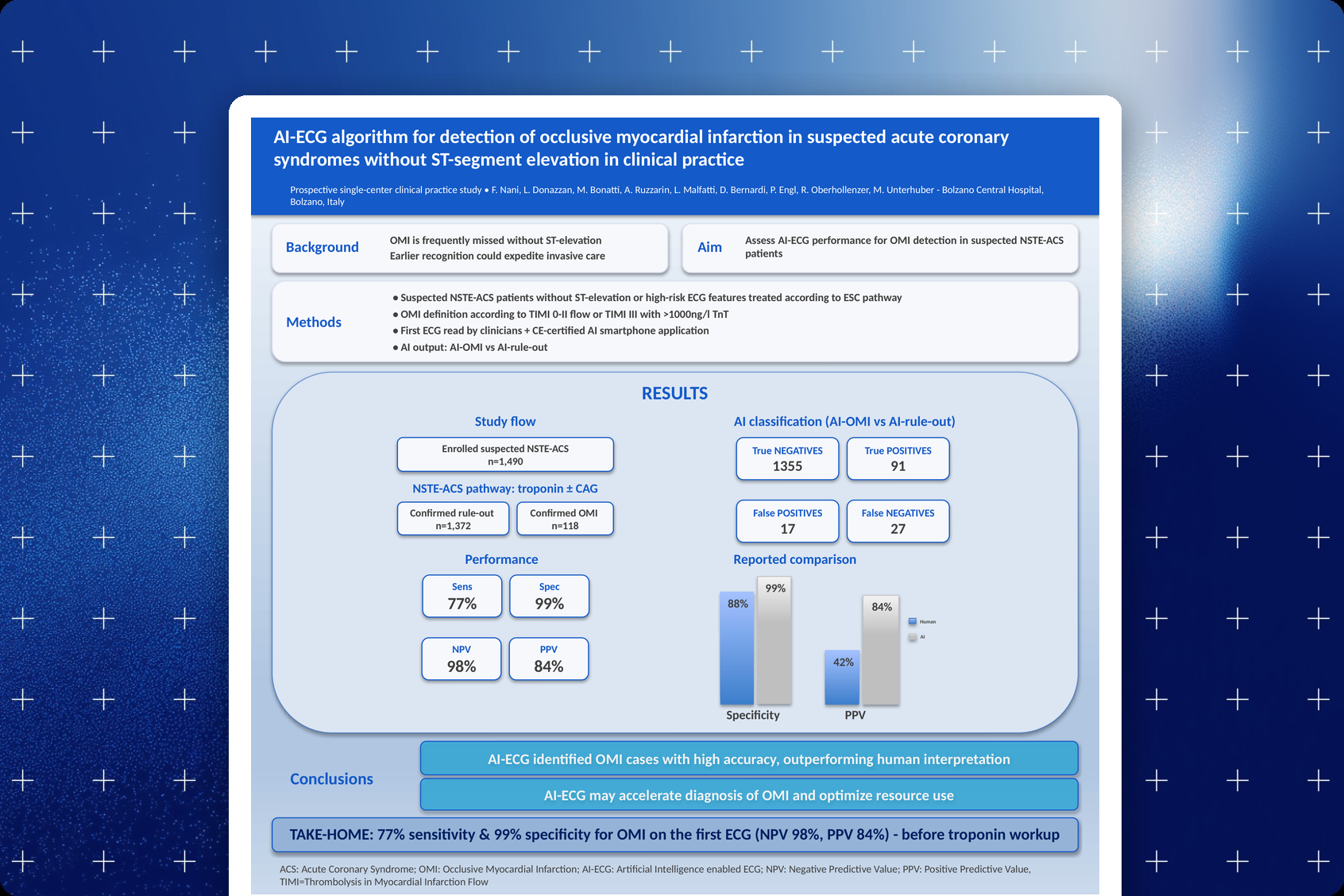
Occlusive myocardial infarction (OMI) is often missed when the ECG shows no ST-segment elevation, even by experienced clinicians. In this prospective single-center study at Bolzano Central Hospital, Italy, the first ECG of 1,490 patients with suspected acute coronary syndrome without ST elevation was analyzed by a commercially available, CE-certified smartphone AI-ECG algorithm alongside routine clinician interpretation. Based on the ECG alone and before troponin results, the AI detected OMI with 77% sensitivity and 99% specificity (negative predictive value 98%, positive predictive value 84%). By comparison, the guideline-directed pathway reached 88% specificity and a 42% positive predictive value.
Key findings
- On the first ECG alone, AI-ECG detected occlusive MI with 77% sensitivity and 99% specificity, before any troponin results.
- AI-ECG reached a 98% negative predictive value and an 84% positive predictive value for occlusive MI among 1,490 patients with suspected ACS without ST elevation.
- Specificity was 99% with AI-ECG vs 88% with the guideline-directed pathway, and positive predictive value 84% vs 42%.
- AI-ECG flagged 108 of 1,490 patients (7%) as OMI, with 17 false positives (1%) and 27 false negatives (2%).
Published in: European Heart Journal. Acute Cardiovascular Care – presented at ACVC 2026 (ESC Acute CardioVascular Care congress), Lisbon, 20 March 2026
Presented on: 20 March 2026
Background
Accurate recognition of occlusive myocardial infarction (OMI) in acute coronary syndromes (ACS) without ST-segment elevation remains challenging, even for skilled clinicians. Artificial intelligence applied to ECG interpretation (AI-ECG) could improve diagnostic accuracy and the timing of patient management. This study assessed the performance of AI-ECG in detecting OMI based solely on automated ECG interpretation, compared with human interpretation.
Methods
In this prospective single-center study at Bolzano Central Hospital, Italy, patients with symptoms suggestive of ACS without ST elevation were enrolled and managed according to the European Society of Cardiology (ESC) NSTE-ACS pathway (serial troponin ± coronary angiography). All first ECGs at presentation were analyzed by clinicians. In parallel, the same ECGs were analyzed by a smartphone-based, commercially available, CE-certified AI-ECG algorithm and classified as AI-OMI or AI-Rule-Out. OMI was defined as TIMI flow 0–II, or TIMI III flow with troponin T >1,000 ng/L. Final diagnoses were used to assess the performance of both clinicians and AI-ECG.
Results
Of 1,490 enrolled patients, AI-ECG classified 108 (7%) as AI-OMI and 1,382 as AI-Rule-Out. Following the guideline-directed pathway, 1,207 patients were ruled out on negative or stable serial troponin values and 283 underwent coronary angiography; 118 patients had confirmed OMI. AI-ECG identified 91 true positives and 1,355 true negatives, with 17 false positives (1%) and 27 false negatives (2%), corresponding to 77% sensitivity, 99% specificity, 98% negative predictive value and 84% positive predictive value for OMI. The guideline-directed pathway achieved 88% specificity and a 42% positive predictive value.
Conclusion
The AI-ECG algorithm identified and excluded occlusive myocardial infarction in patients with suspected ACS without ST elevation more accurately than conventional expert interpretation, before troponin results were available. Its integration into routine practice may accelerate diagnosis, enable earlier treatment and promote more efficient use of medical resources.
Share this article



About PMcardio
PMcardio is the market leader in AI-powered diagnostics, addressing the world’s leading cause of death – cardiovascular diseases. The innovative clinical assistant empowers healthcare professionals to detect up to 40 cardiovascular diseases. In the form of a smartphone application, the certified Class IIb medical device interprets any 12-lead ECG image in under 5 seconds to provide accurate diagnoses and individualized treatment recommendations tailored to each patient.

About Powerful Medical
Powerful Medical leads one of the most important shifts in modern medicine by augmenting human-made clinical decisions with artificial intelligence. Our primary focus is on cardiovascular diseases, the world’s leading cause of death.
Established in 2017, Powerful Medical has embarked on a mission to revolutionize the diagnosis and treatment of cardiovascular diseases. We are a medical company backed by 28 world-class cardiologists and led by our expert Scientific Board with decades of experience in daily patient care, clinical research, and medical devices. The results of our research are implemented, developed, certified, and brought to market by our 50+ strong interdisciplinary team of physicians, data scientists, AI experts, software engineers, regulatory specialists, and commercial teams.