
Artificial intelligence–enabled ECG-identification of occlusive myocardial infarction in non-ST-elevation acute coronary syndrome and association with infarct size and survival
Overview
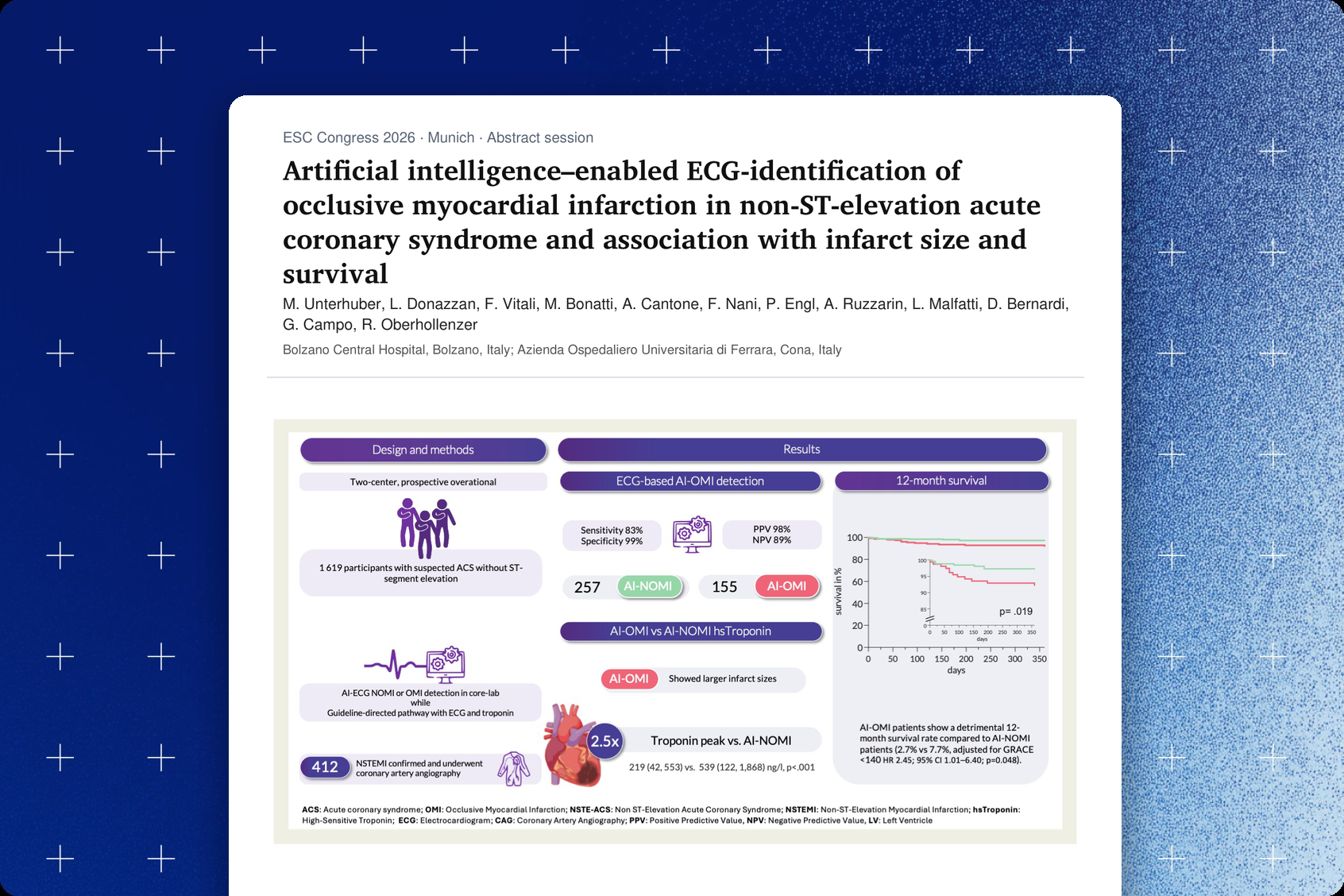
This independent, two-center observational study from the ANOMI registry in Italy applied the PMcardio Queen of Hearts AI-ECG model (aOMI v1) in a blinded core lab to 1,619 patients with suspected acute coronary syndrome without ST elevation. The AI model detected occlusive myocardial infarction (OMI) with 83% sensitivity, 99% specificity, a 98% positive predictive value and an 89% negative predictive value. Among 412 patients with confirmed NSTEMI who underwent coronary angiography, the 155 (37.6%) classified as AI-OMI had similar troponin at presentation but higher peak troponin (539 vs 219 ng/L). At 12 months, 7.7% of AI-OMI patients and 2.7% of AI-negative patients had died, and AI-OMI remained independently associated with 12-month mortality after adjustment for GRACE score above 140 (HR 2.45).
Key findings
- The AI model detected OMI with 83% sensitivity, 99% specificity, a 98% positive predictive value and an 89% negative predictive value.
- Of 412 patients with confirmed NSTEMI who underwent coronary angiography, 155 (37.6%) were classified as AI-OMI.
- Baseline troponin was similar (61 vs 59 ng/L, p=0.8), but peak troponin was higher in AI-OMI than in AI-negative patients (539 vs 219 ng/L, p<0.001).
- At 12 months, 12 AI-OMI patients (7.7%) and 7 AI-negative patients (2.7%) had died; AI-OMI was independently associated with mortality after adjustment for GRACE score above 140 (HR 2.45, 95% CI 1.01–6.40).
Published in: ESC Congress 2026 – presented as an oral abstract
Published on: 28 August 2026
Background
Rapid identification of occlusive myocardial infarction (OMI) remains challenging in acute coronary syndrome (ACS) without ST elevation. Artificial intelligence-assisted electrocardiography (AI-ECG) may enable early recognition before the routine workup and allow access to timely reperfusion.
Methods
In this two-center observational study (ANOMI registry, NCT06910436), patients with suspected ACS were enrolled, managed according to current guidelines and followed the standard ACS pathway; ST-elevation myocardial infarction (STEMI) was excluded. Serial high-sensitivity troponin T measurements were collected, and patients underwent coronary angiography when needed. OMI was defined as an acute culprit lesion with reduced TIMI flow, or apparently normal flow with peak troponin above 1,000 ng/L. ECGs were analyzed in a blinded core lab with the PMcardio Queen of Hearts AI-ECG model (aOMI v1), which classified patients as AI-OMI or AI-NOMI (no signs of occlusive myocardial infarction). Cardiovascular death at 12 months was evaluated with Kaplan–Meier analyses.
Results
Among 1,619 patients with suspected non-ST-elevation ACS (mean age 69±17 years, 41% women), 412 (25%) had confirmed NSTEMI and underwent coronary angiography; 155 of them (37.6%) were classified as AI-OMI. For OMI detection, the AI-ECG model reached a sensitivity of 83%, a specificity of 99%, a positive predictive value of 98% and a negative predictive value of 89%. Baseline troponin levels were comparable between groups (61 [7–205] vs 59 [8–218] ng/L, p=0.8), whereas peak troponin was significantly higher in AI-OMI patients (539 [122–1,868] vs 219 [42–553] ng/L, p<0.001). At 12 months of follow-up, 7 AI-NOMI patients (2.7%) and 12 AI-OMI patients (7.7%) had died (log-rank p=0.019). After adjustment for a GRACE score above 140, AI-OMI was independently associated with increased 12-month mortality (HR 2.45, 95% CI 1.01–6.40, p=0.048).
Conclusion
In non-ST-elevation ACS, the prevalence of OMI is high and OMI often remains clinically unrecognized. In this study, AI-ECG accurately identified OMI, and patients classified as AI-OMI had higher peak troponin values and higher 12-month cardiovascular mortality, independently of the GRACE score. AI-ECG may redefine early triage of non-ST-elevation ACS at first medical contact.
Share this article



About PMcardio
PMcardio is the market leader in AI-powered diagnostics, addressing the world’s leading cause of death – cardiovascular diseases. The innovative clinical assistant empowers healthcare professionals to detect up to 40 cardiovascular diseases. In the form of a smartphone application, the certified Class IIb medical device interprets any 12-lead ECG image in under 5 seconds to provide accurate diagnoses and individualized treatment recommendations tailored to each patient.

About Powerful Medical
Powerful Medical leads one of the most important shifts in modern medicine by augmenting human-made clinical decisions with artificial intelligence. Our primary focus is on cardiovascular diseases, the world’s leading cause of death.
Established in 2017, Powerful Medical has embarked on a mission to revolutionize the diagnosis and treatment of cardiovascular diseases. We are a medical company backed by 28 world-class cardiologists and led by our expert Scientific Board with decades of experience in daily patient care, clinical research, and medical devices. The results of our research are implemented, developed, certified, and brought to market by our 50+ strong interdisciplinary team of physicians, data scientists, AI experts, software engineers, regulatory specialists, and commercial teams.