
Artificial Intelligence ECG Model To Reduce False-Positive STEMI Alerts in the Emergency Department
Overview
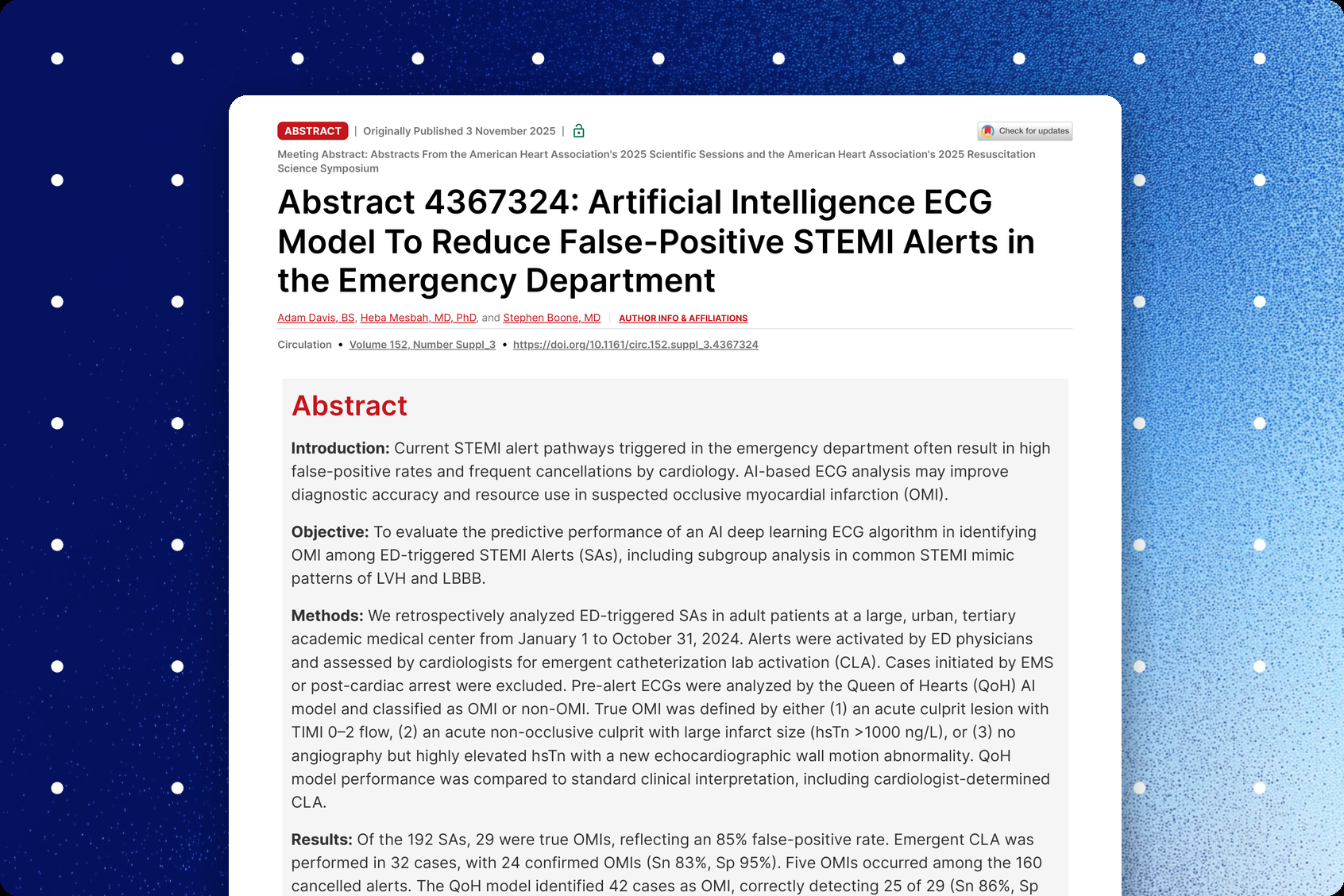
This independent, retrospective study from a large urban tertiary academic medical center analyzed 192 STEMI alerts triggered in the emergency department between January and October 2024, of which only 29 were true occlusion myocardial infarctions (OMI), an 85% false-positive rate. Applied to the pre-alert ECGs, the PMcardio Queen of Hearts AI model (aOMI v1) flagged 42 alerts as OMI and detected 25 of the 29 OMIs (sensitivity 86%, specificity 89%), including 3 of the 5 OMIs missed by cardiology. Cardiologist-determined emergent cath lab activation reached 83% sensitivity and 95% specificity. In the 58 alerts with left ventricular hypertrophy (LVH), a common STEMI mimic, the AI model had 100% sensitivity and 95% specificity.
Key findings
- Of 192 ED-triggered STEMI alerts, only 29 were true OMIs, an 85% false-positive rate.
- The Queen of Hearts AI model flagged 42 alerts as OMI and detected 25 of 29 OMIs (sensitivity 86%, specificity 89%), compared with 83% sensitivity and 95% specificity for cardiologist-determined cath lab activation.
- Five OMIs were among the 160 alerts cancelled by cardiology; the AI model identified 3 of them.
- In 58 alerts with LVH, the AI model identified both true OMIs (sensitivity 100%, specificity 95%); none of the 13 LBBB alerts were OMI (AI specificity 92%).
Published in: American Heart Association (AHA) Scientific Sessions 2025 – presented in the session “AI, Advanced Imaging & Rapid Diagnostics in ACS”; abstract published in Circulation (AHA Journals)
Published on: 10 November 2025
Background
STEMI alert pathways triggered in the emergency department (ED) often have high false-positive rates and frequent cancellations by cardiology. AI-based ECG analysis may improve diagnostic accuracy and resource use in suspected occlusion myocardial infarction (OMI). This study evaluated the predictive performance of an AI deep learning ECG algorithm in identifying OMI among ED-triggered STEMI alerts, including subgroup analyses in two common STEMI mimics, left ventricular hypertrophy (LVH) and left bundle branch block (LBBB).
Methods
The authors retrospectively analyzed ED-triggered STEMI alerts in adult patients at a large, urban, tertiary academic medical center from January 1 to October 31, 2024. Alerts were activated by ED physicians and assessed by cardiologists for emergent catheterization lab activation (CLA); alerts initiated by EMS or after cardiac arrest were excluded. Pre-alert ECGs were analyzed by the PMcardio Queen of Hearts AI model (aOMI v1) and classified as OMI or non-OMI. True OMI was defined as (1) an acute culprit lesion with TIMI 0–2 flow, (2) an acute non-occlusive culprit with large infarct size (hsTn >1000 ng/L), or (3) no angiography but highly elevated hsTn with a new echocardiographic wall motion abnormality. Model performance was compared with standard clinical interpretation, including cardiologist-determined CLA.
Results
Of the 192 STEMI alerts, 29 were true OMIs, reflecting an 85% false-positive rate. Emergent CLA was performed in 32 cases, 24 of which were confirmed OMIs (sensitivity 83%, specificity 95%), and 5 OMIs occurred among the 160 cancelled alerts. The AI model identified 42 cases as OMI, correctly detecting 25 of the 29 OMIs (sensitivity 86%, specificity 89%), including 3 of the 5 missed by cardiology. Among 58 alerts with LVH, the AI model identified both true OMIs (sensitivity 100%, specificity 95%). None of the 13 LBBB cases were OMI (specificity 92%).
Conclusion
The Queen of Hearts AI model has the potential to substantially reduce false-positive ED-triggered STEMI alerts, with diagnostic performance comparable to cardiologist-determined cath lab activation. It identified OMI cases missed by standard clinical evaluation and was highly accurate in patients with LVH, a common STEMI mimic in this population, supporting AI-assisted ECG interpretation to improve triage accuracy and resource use in acute cardiac care.
Share this article



About PMcardio
PMcardio is the market leader in AI-powered diagnostics, addressing the world’s leading cause of death – cardiovascular diseases. The innovative clinical assistant empowers healthcare professionals to detect up to 40 cardiovascular diseases. In the form of a smartphone application, the certified Class IIb medical device interprets any 12-lead ECG image in under 5 seconds to provide accurate diagnoses and individualized treatment recommendations tailored to each patient.

About Powerful Medical
Powerful Medical leads one of the most important shifts in modern medicine by augmenting human-made clinical decisions with artificial intelligence. Our primary focus is on cardiovascular diseases, the world’s leading cause of death.
Established in 2017, Powerful Medical has embarked on a mission to revolutionize the diagnosis and treatment of cardiovascular diseases. We are a medical company backed by 28 world-class cardiologists and led by our expert Scientific Board with decades of experience in daily patient care, clinical research, and medical devices. The results of our research are implemented, developed, certified, and brought to market by our 50+ strong interdisciplinary team of physicians, data scientists, AI experts, software engineers, regulatory specialists, and commercial teams.