
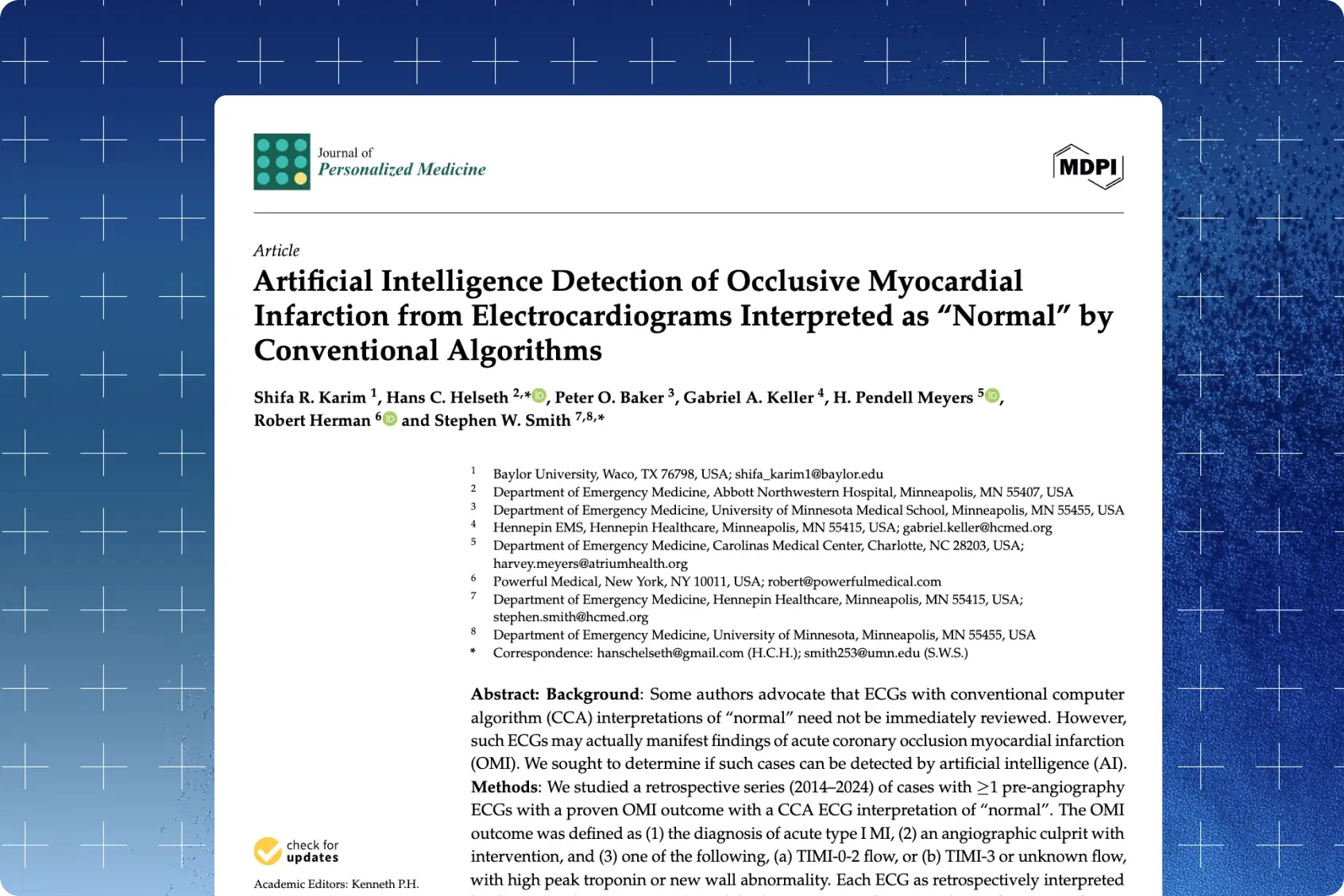
Artificial Intelligence Detection of Occlusive Myocardial Infarction from Electrocardiograms Interpreted as “Normal” by Conventional Algorithms
Overview
Conventional ECG algorithms, humanly programmed to detect abnormalities based on fiducial points, frequently miss critical patterns of STEMI. AI-driven deep neural network models like PMcardio AI ECG offer significant potential in identifying these dangerous false negatives, reducing the risk of false reassurance, and enhancing clinical decision-making.
Key findings
- Conventional rule-based ECG algorithms miss critical STEMI patterns.
- AI detected occlusion MI in ECGs interpreted as ‘normal’.
- Reduces false-negative reassurance and supports safer decisions.
Published in: Journal of Personalized Medicine Presented Date: March 28, 2025
Background
Some authors advocate that ECGs with conventional computer algorithm (CCA) interpretations of “normal” need not be immediately reviewed. However, such ECGs may actually manifest findings of acute coronary occlusion myocardial infarction (OMI). We sought to determine if such cases can be detected by artificial intelligence (AI).
Methods
We studied a retrospective series (2014–2024) of cases with ≥1 pre-angiography ECGs with a proven OMI outcome with a CCA ECG interpretation of “normal”. The OMI outcome was defined as (1) the diagnosis of acute type I MI, (2) an angiographic culprit with intervention, and (3) one of the following, (a) TIMI-0-2 flow, or (b) TIMI-3 or unknown flow, with high peak troponin or new wall abnormality. Each ECG as retrospectively interpreted by the PMcardio OMI AI ECG model. The primary analysis was the performance of AI in diagnosing “OMI” among these CCA “normal” ECGs.
Results
Forty-two patients with OMI met the inclusion criteria. The first ECG was interpreted as “normal” by the CCA in 88% of cases; AI interpreted 81% as OMI and 86% as abnormal. Of the 78 total ECGs interpreted by the CCA, 73% were diagnosed as “normal”. Of this 73%, AI identified 81% as abnormal and 72% as OMI.
Conclusion
The Conventional Computer Algorithm may interpret an ECG manifesting OMI as “normal”. AI not only recognized these as abnormal, but in 81% of patients, correctly recognized OMI on the first ECG and recognized 72% of all the CCA “normal” ECGs as OMI. It was rare for AI to diagnose a normal ECG for any OMI patient.
Share this article



About PMcardio
PMcardio is the market leader in AI-powered diagnostics, addressing the world’s leading cause of death – cardiovascular diseases. The innovative clinical assistant empowers healthcare professionals to detect up to 40 cardiovascular diseases. In the form of a smartphone application, the certified Class IIb medical device interprets any 12-lead ECG image in under 5 seconds to provide accurate diagnoses and individualized treatment recommendations tailored to each patient.

About Powerful Medical
Powerful Medical leads one of the most important shifts in modern medicine by augmenting human-made clinical decisions with artificial intelligence. Our primary focus is on cardiovascular diseases, the world’s leading cause of death.
Established in 2017, Powerful Medical has embarked on a mission to revolutionize the diagnosis and treatment of cardiovascular diseases. We are a medical company backed by 28 world-class cardiologists and led by our expert Scientific Board with decades of experience in daily patient care, clinical research, and medical devices. The results of our research are implemented, developed, certified, and brought to market by our 50+ strong interdisciplinary team of physicians, data scientists, AI experts, software engineers, regulatory specialists, and commercial teams.