
AI ECG Prediction of Infarct-Related Artery in STEMI Independent of ST-Segment Elevation Criteria
Overview
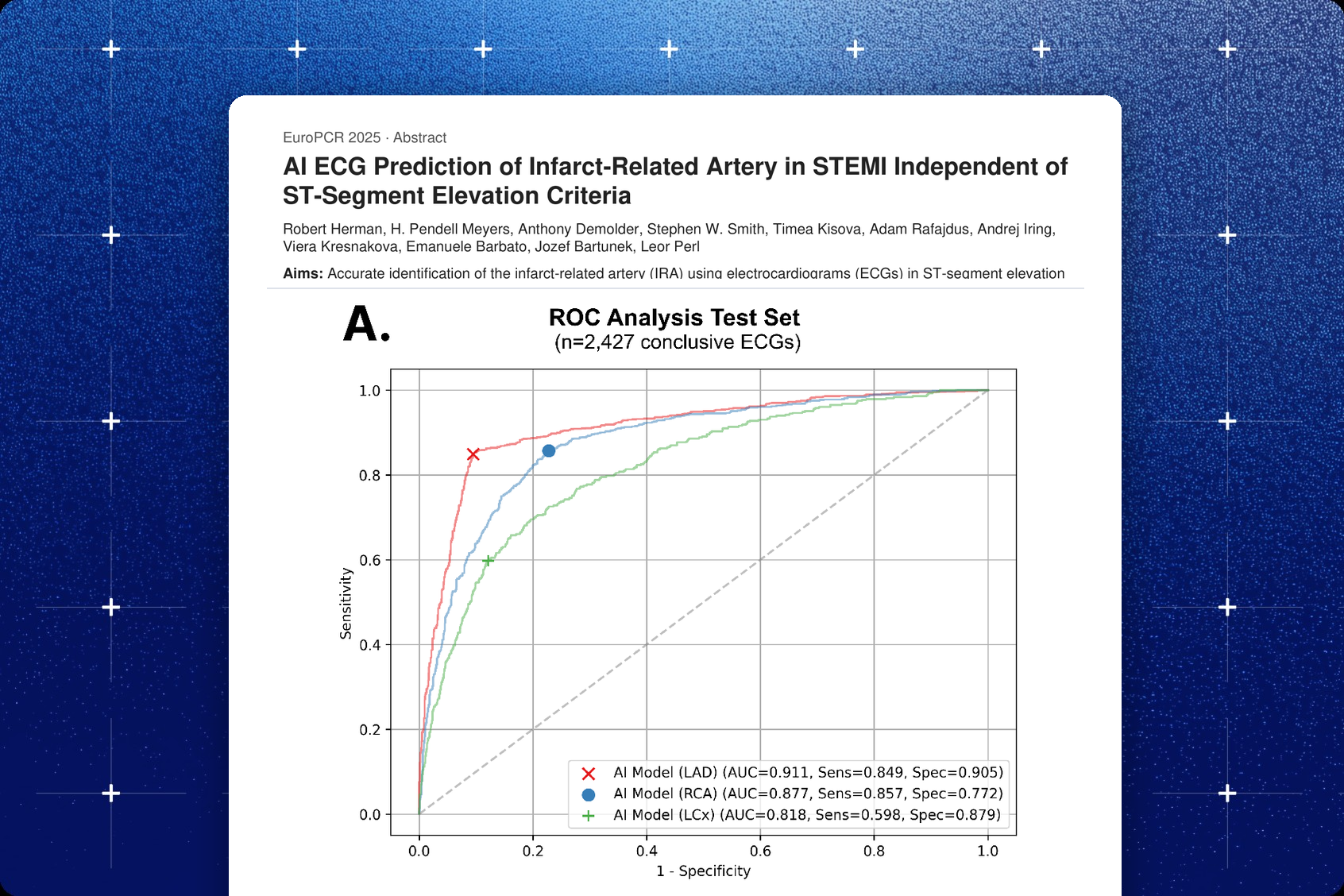
Approximately 40% of STEMI patients present without typical ST-segment elevation, which makes standard ECG rules for locating the infarct-related artery (IRA) difficult to apply. This study developed an AI-ECG model on 30,212 ECGs from 5,343 patients, pooled from seven tertiary care centers, to predict whether the IRA is the LAD, RCA or LCx from a single 12-lead ECG. In a test set of 2,528 ECGs from 812 patients, 96% of ECGs received a conclusive prediction, with AUCs of 0.911 for LAD, 0.877 for RCA and 0.818 for LCx. Performance was similar in ECGs with and without STEMI millimeter criteria, although sensitivity for LCx culprits was lower when STEMI criteria were not met.
Key findings
- In the test set of 2,528 ECGs from 812 patients, 2,427 ECGs (96%) received a conclusive IRA prediction.
- On conclusive ECGs, the model achieved AUCs of 0.911 for LAD, 0.877 for RCA and 0.818 for LCx culprits, with sensitivities of 84.9%, 85.7% and 59.8%.
- In ECGs meeting STEMI millimeter criteria, AUCs were 0.935 (LAD), 0.917 (RCA) and 0.842 (LCx).
- In ECGs without STEMI criteria, AUCs remained high at 0.903 (LAD), 0.869 (RCA) and 0.813 (LCx), with a notable reduction in sensitivity only for LCx culprits.
Published in: EuroPCR 2025
Published on: 22 May 2025
Background
Accurate identification of the infarct-related artery (IRA) on the electrocardiogram (ECG) in ST-segment elevation myocardial infarction (STEMI) has important procedural implications. Contemporary rules are effective in patients presenting with ST-segment elevation (STE), but approximately 40% of STEMI patients present without typical STE (STEMI equivalents), which introduces significant diagnostic complexity. The authors developed and validated an artificial intelligence (AI)-powered model to predict the IRA in STEMI or STEMI equivalents regardless of STE.
Methods
ECG waveforms and laboratory and angiographic parameters of both STEMI and STEMI-equivalent patients were pooled from seven geographically distinct tertiary care centers. Patients with missing information, left main disease or multivessel culprits were excluded. Using angiographic findings, the IRA was classified as the left anterior descending (LAD), right coronary (RCA) or left circumflex (LCx) artery, with side branches categorized under their respective main coronary arteries. ECGs were classified based on the presence of contemporary STE millimeter criteria. The AI model was developed using 30,212 12-lead ECG waveforms from 5,343 patients. It outputs three probabilities and selects the artery with the highest value; if all probabilities are below 0.5, the result is labeled inconclusive.
Results
The test set included 2,528 ECGs from 812 patients. The IRA was the LAD in 344 (42%), the RCA in 309 (38%) and the LCx in 159 (20%) patients. A total of 2,427 ECGs (96%) had a conclusive IRA prediction. Across all conclusive ECGs, the AI model showed AUCs of 0.911 (LAD), 0.877 (RCA) and 0.818 (LCx), with sensitivities of 0.849, 0.857 and 0.598 and specificities of 0.905, 0.772 and 0.879, respectively. For ECGs meeting STEMI criteria, the AI model achieved AUCs of 0.935 (LAD), 0.917 (RCA) and 0.842 (LCx), while for ECGs not meeting STEMI criteria the AUCs were 0.903 (LAD), 0.869 (RCA) and 0.813 (LCx). Sensitivity and specificity were consistently high, with the exception of a notable reduction in sensitivity for LCx culprits in ECGs not meeting STEMI criteria.
Conclusion
The AI model showed high performance in predicting the IRA from single 12-lead ECGs in STEMI patients, independent of millimeter ST-segment elevation. Its potential to improve procedural planning warrants further validation in prospective cohorts to assess clinical utility.
Share this article



About PMcardio
PMcardio is the market leader in AI-powered diagnostics, addressing the world’s leading cause of death – cardiovascular diseases. The innovative clinical assistant empowers healthcare professionals to detect up to 40 cardiovascular diseases. In the form of a smartphone application, the certified Class IIb medical device interprets any 12-lead ECG image in under 5 seconds to provide accurate diagnoses and individualized treatment recommendations tailored to each patient.

About Powerful Medical
Powerful Medical leads one of the most important shifts in modern medicine by augmenting human-made clinical decisions with artificial intelligence. Our primary focus is on cardiovascular diseases, the world’s leading cause of death.
Established in 2017, Powerful Medical has embarked on a mission to revolutionize the diagnosis and treatment of cardiovascular diseases. We are a medical company backed by 28 world-class cardiologists and led by our expert Scientific Board with decades of experience in daily patient care, clinical research, and medical devices. The results of our research are implemented, developed, certified, and brought to market by our 50+ strong interdisciplinary team of physicians, data scientists, AI experts, software engineers, regulatory specialists, and commercial teams.