
AI-Assisted Electrocardiogram Interpretation Improves ST-Elevation Myocardial Infarction Diagnostic Accuracy Among Advanced Practice Providers: A Prospective Randomized Crossover Study
Overview
In military operational settings, advanced practice providers are often the first or only clinicians able to recognize a STEMI, yet AI-ECG tools had not been tested with them. In this prospective, randomized, multi-reader crossover study at Carl R. Darnall Army Medical Center (Fort Hood, TX), 21 certified physician assistants interpreted 50 de-identified 12-lead ECGs (25 STEMI, 25 non-STEMI) with and without the PMcardio Queen of Hearts (QoH) AI model. With AI assistance, diagnostic accuracy rose from 79.0% to 92.9%, sensitivity from 82.5% to 95.4% and specificity from 75.6% to 90.5%, and readers were more confident. Interpretation took longer with AI, by about 14 seconds per ECG, which the authors judged unlikely to be clinically meaningful.
Key findings
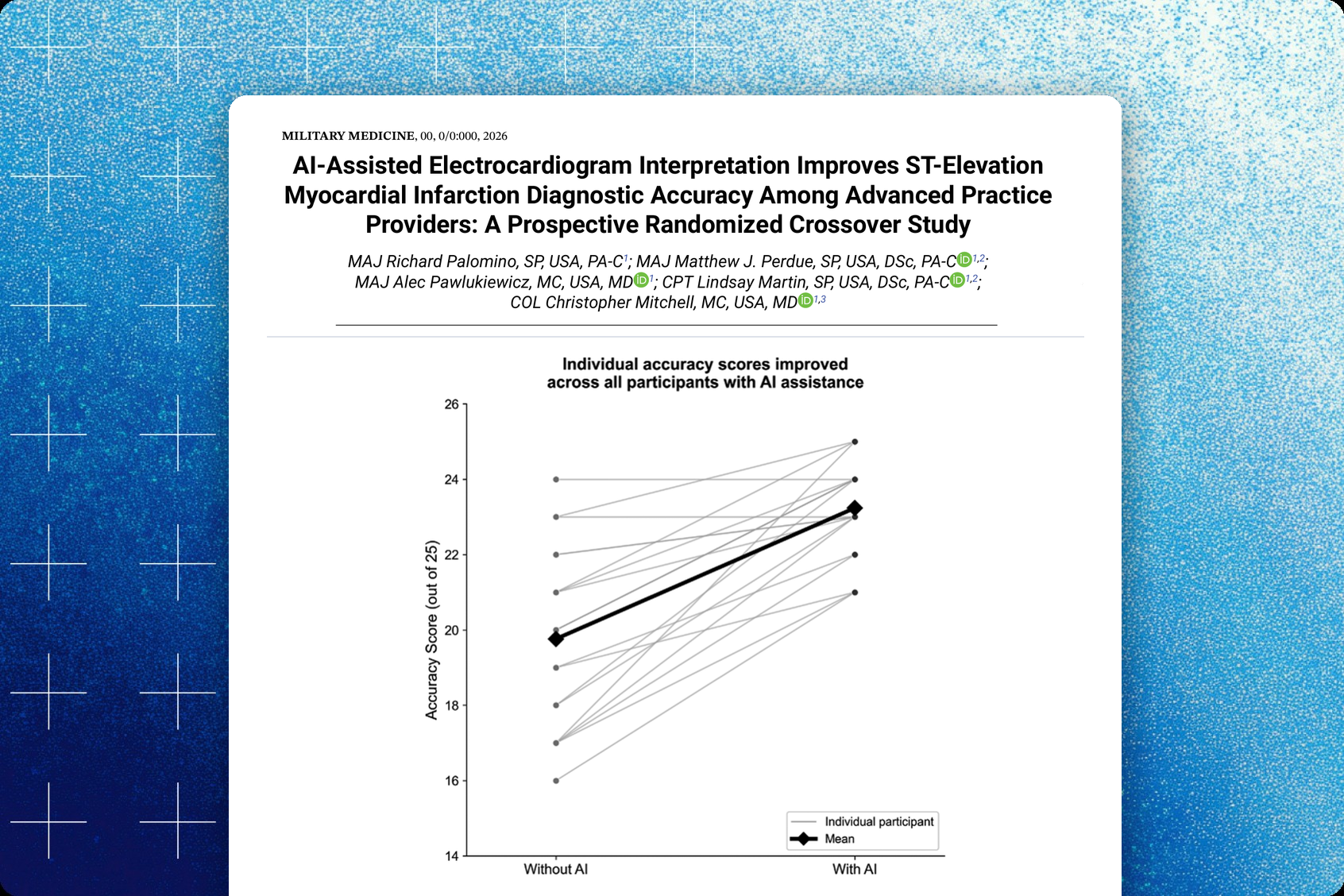
- STEMI diagnostic accuracy improved from 79.0% without AI to 92.9% with Queen of Hearts assistance (mean 19.76 vs 23.24 correct out of 25; P < .001), a 13.9-percentage-point gain.
- Pooled sensitivity rose from 82.5% to 95.4% and specificity from 75.6% to 90.5%, with PPV increasing from 77.1% to 90.9% and NPV from 81.3% to 95.2%.
- Interrater agreement improved from moderate (κ = 0.58) to excellent (κ = 0.86), and 19 of 21 physician assistants improved their accuracy with AI while the other 2 kept the same score.
- Mean time per 25-ECG block increased from 13.05 to 18.76 minutes with AI (about 14 seconds more per ECG), while confidence improved (Likert total 46.76 vs 56.90; lower is more confident).
Published in: Military Medicine
Published on: 4 August 2026
Background
Timely and accurate STEMI diagnosis is critical in military operational environments, where evacuation may be delayed and advanced practice providers (APPs) are often the first or only clinicians able to assess time-sensitive emergencies, especially in Role I and Role II settings. AI-ECG tools have shown high diagnostic performance, but few studies have tested them in multi-reader settings and none had evaluated their effect on APPs' confidence or time-to-decision. This study assessed whether ECG interpretation assisted by the PMcardio Queen of Hearts (QoH) AI model improves STEMI diagnostic accuracy, clinician confidence and time-to-decision among APPs.
Methods
In a prospective, randomized, multi-reader, multi-case crossover study at Carl R. Darnall Army Medical Center (Fort Hood, TX), 21 certified physician assistants (PA-Cs) from emergency medicine and a range of operational units interpreted a standardized set of 50 de-identified 12-lead ECGs (25 STEMI, 25 non-STEMI) from publicly available educational sources, with labels verified by 2 board-certified emergency medicine physicians. The ECGs were split into 2 blocks of 25 balanced for difficulty, and participants were randomized to block order and to whether they read with or without AI first; each served as their own control. In the AI-assisted condition, participants used the PMcardio mobile app with QoH as a decision-support aid, under a forward-only workflow with a 30-minute limit per block. Data were collected between 2 January and 28 February 2026. The primary outcome was diagnostic accuracy; secondary outcomes were confidence (sum of 5-point Likert ratings, lower meaning more confident) and time-to-decision, analyzed with paired t-tests and a random-effects crossover model.
Results
All 21 participants completed the protocol. Mean accuracy was 23.24 out of 25 (92.9%) with AI versus 19.76 out of 25 (79.0%) without AI (P < .001; Cohen d = 1.68), exceeding the predefined clinically meaningful difference of 10 percentage points. With AI, pooled sensitivity was 95.4% and specificity 90.5%, compared with 82.5% and 75.6% without AI; PPV rose from 77.1% to 90.9% and NPV from 81.3% to 95.2%. Interrater agreement increased from κ = 0.58 to κ = 0.86, and 19 of 21 participants (90.5%) improved their accuracy, with the remaining 2 maintaining their scores. In the crossover model, AI was the only significant predictor of accuracy (coefficient 3.46; P < .001), with no significant effect of testing period or sequence. Confidence improved with AI (mean Likert total 46.76 vs 56.90; P < .001), while time-to-decision per 25-ECG block increased from 13.05 to 18.76 minutes (P < .001), roughly 14 seconds more per ECG. Enrollment of 21 participants fell short of the 34 estimated by the a priori power analysis.
Conclusion
AI-assisted ECG interpretation with Queen of Hearts significantly improved STEMI diagnostic accuracy and confidence among Army physician assistants. The modest added time per ECG is unlikely to be clinically meaningful, supporting the integration of AI-ECG decision support into frontline and operational military settings.
Share this article



About PMcardio
PMcardio is the market leader in AI-powered diagnostics, addressing the world’s leading cause of death – cardiovascular diseases. The innovative clinical assistant empowers healthcare professionals to detect up to 40 cardiovascular diseases. In the form of a smartphone application, the certified Class IIb medical device interprets any 12-lead ECG image in under 5 seconds to provide accurate diagnoses and individualized treatment recommendations tailored to each patient.

About Powerful Medical
Powerful Medical leads one of the most important shifts in modern medicine by augmenting human-made clinical decisions with artificial intelligence. Our primary focus is on cardiovascular diseases, the world’s leading cause of death.
Established in 2017, Powerful Medical has embarked on a mission to revolutionize the diagnosis and treatment of cardiovascular diseases. We are a medical company backed by 28 world-class cardiologists and led by our expert Scientific Board with decades of experience in daily patient care, clinical research, and medical devices. The results of our research are implemented, developed, certified, and brought to market by our 50+ strong interdisciplinary team of physicians, data scientists, AI experts, software engineers, regulatory specialists, and commercial teams.