
AI-Assisted ECG Chest Pain Triage Reduces Time to Reperfusion in STEMI and Improves Short-term Outcomes
Overview
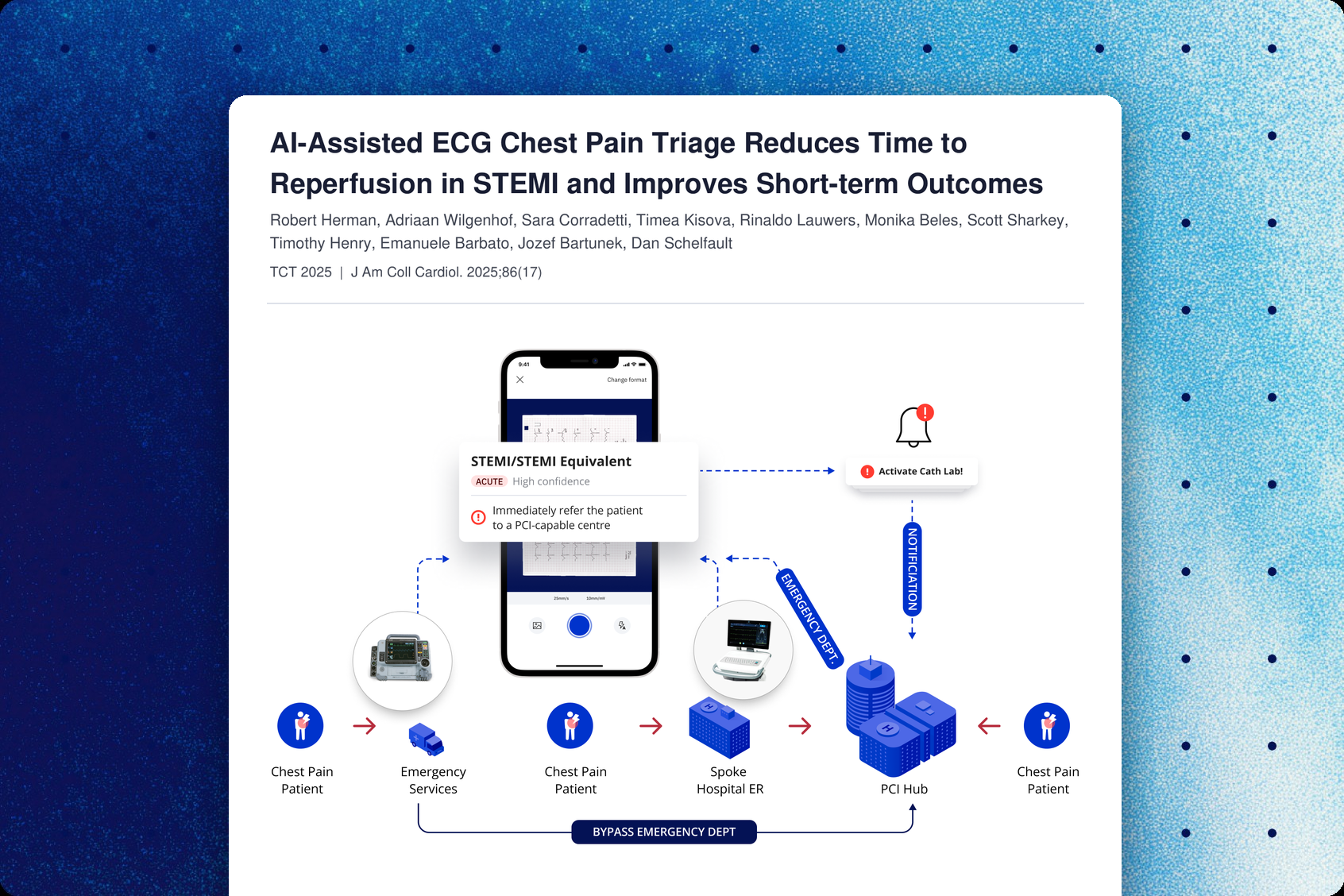
This before-and-after study from the AZORG Aalst (Belgium) STEMI network compared the six months before and the six months after implementation of an AI-assisted chest-pain pathway built on the PMcardio Queen of Hearts AI-ECG model. Among 140 patients with acute coronary syndrome and an angiographic culprit vessel (67 before AI, 73 after), door-to-balloon time fell from 99 to 51 minutes overall and from 530 to 148 minutes in patients with STEMI-equivalent ECGs. The share of patients reperfused within 90 minutes rose from 44.8% to 65.8%. Peak troponin and in-hospital deaths were also lower after AI (1,876 vs 2,416 ng/L; 1 vs 3 deaths), even though the AI report was viewed by the ED physician within 10 minutes in only 68% of patients.
Key findings
- After AI implementation, door-to-balloon time fell from 99 to 51 minutes overall and from 64 to 47 minutes in typical STEMI.
- In patients with STEMI-equivalent ECGs, door-to-balloon time fell from 530 to 148 minutes, a saving of about six hours.
- The proportion of patients with a door-to-balloon time under 90 minutes rose from 44.8% to 65.8%.
- Peak troponin (2,416 vs 1,876 ng/L) and in-hospital deaths (3 vs 1 patients) were lower after AI, although the AI ECG report was viewed by the ED physician within 10 minutes in only 68% of patients.
Published in: TCT 2025 – presented as an oral presentation; abstract published in the Journal of the American College of Cardiology (JACC)
Published on: 27 October 2025
Background
Patients whose coronary occlusion is not recognized on the initial ECG, particularly those with STEMI-equivalent patterns that do not meet millimeter STEMI criteria, can wait hours for reperfusion and may be discharged with a diagnosis of NSTEMI. The PMcardio Queen of Hearts model is an AI-ECG model trained to detect angiographically confirmed STEMI or STEMI equivalents. This study evaluated whether introducing an AI-assisted chest-pain pathway at first medical contact shortens time to reperfusion and improves short-term outcomes.
Methods
The AI-assisted chest-pain pathway was implemented for six months across the AZORG Aalst STEMI network, covering first medical contact by emergency medical services, at spoke emergency departments and at the hub emergency department. Patients with acute coronary syndrome and an angiographic culprit vessel treated in January–June 2023 (before AI) were compared with those treated in January–June 2024 (after AI). Of 175 patients screened, 35 were excluded (intramural myocardial infarction, n=2; unstable angina, n=12; NSTEMI with late presentation >24 hours, n=21), leaving 140 for analysis (67 before and 73 after AI). Endpoints were the sensitivity of initial-ECG diagnostic criteria (the AI model, ED physicians, the ECG machine's acute MI/STEMI statement and STEMI millimeter criteria), timing to PCI and short-term outcomes.
Results
Baseline characteristics were similar between periods (mean age 68.0 vs 64.8 years; male sex 79.1% vs 75.3%; all p>0.05), as were procedural characteristics, including baseline TIMI 0/1 flow (61.9% vs 62.7%) and PCI performed (96.9% vs 94.6%). After AI implementation, overall door-to-balloon time fell from 99 to 51 minutes, from 64 to 47 minutes in typical STEMI and from 530 to 148 minutes in STEMI equivalents. The proportion of patients with door-to-balloon time under 90 minutes rose from 44.8% to 65.8%. Peak troponin was 2,416 ng/L before and 1,876 ng/L after AI, and in-hospital deaths numbered 3 and 1 patients, respectively. AI use, defined as the AI ECG report being viewed by the ED physician within 10 minutes, occurred in only 68% of patients.
Conclusion
Implementing an AI-assisted ECG chest-pain pathway was associated with a 48-minute shorter overall door-to-balloon time and about six hours shorter door-to-balloon time in patients with STEMI-equivalent ECGs, more patients treated within the 90-minute guideline target, and smaller infarcts and fewer in-hospital deaths after AI.
Share this article



About PMcardio
PMcardio is the market leader in AI-powered diagnostics, addressing the world’s leading cause of death – cardiovascular diseases. The innovative clinical assistant empowers healthcare professionals to detect up to 40 cardiovascular diseases. In the form of a smartphone application, the certified Class IIb medical device interprets any 12-lead ECG image in under 5 seconds to provide accurate diagnoses and individualized treatment recommendations tailored to each patient.

About Powerful Medical
Powerful Medical leads one of the most important shifts in modern medicine by augmenting human-made clinical decisions with artificial intelligence. Our primary focus is on cardiovascular diseases, the world’s leading cause of death.
Established in 2017, Powerful Medical has embarked on a mission to revolutionize the diagnosis and treatment of cardiovascular diseases. We are a medical company backed by 28 world-class cardiologists and led by our expert Scientific Board with decades of experience in daily patient care, clinical research, and medical devices. The results of our research are implemented, developed, certified, and brought to market by our 50+ strong interdisciplinary team of physicians, data scientists, AI experts, software engineers, regulatory specialists, and commercial teams.