
Acute Coronary Occlusion in NSTEMI Patients: Prevalence, Clinical Characteristics and the Potential Role of Artificial Intelligence
Overview
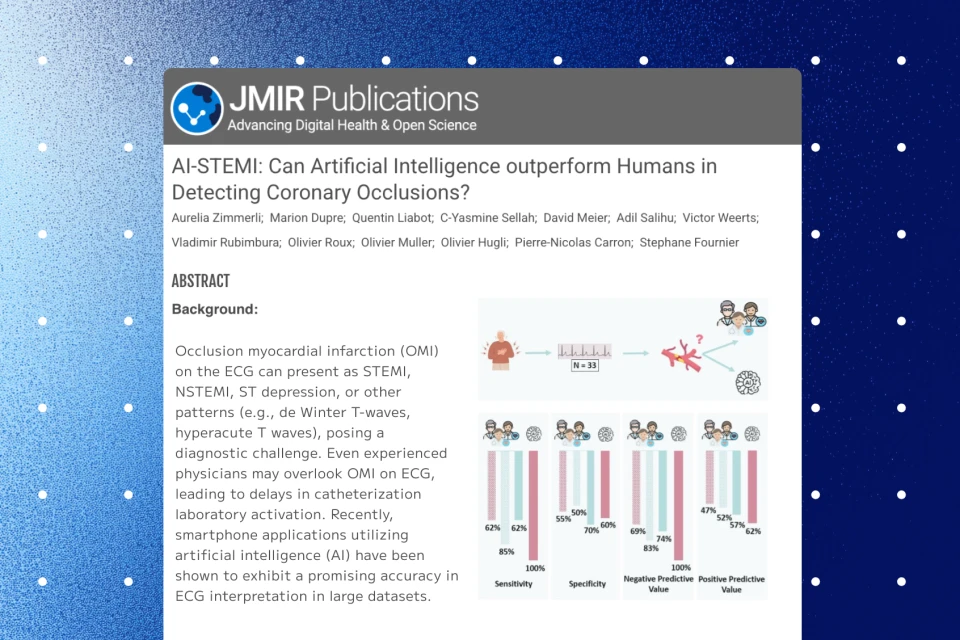
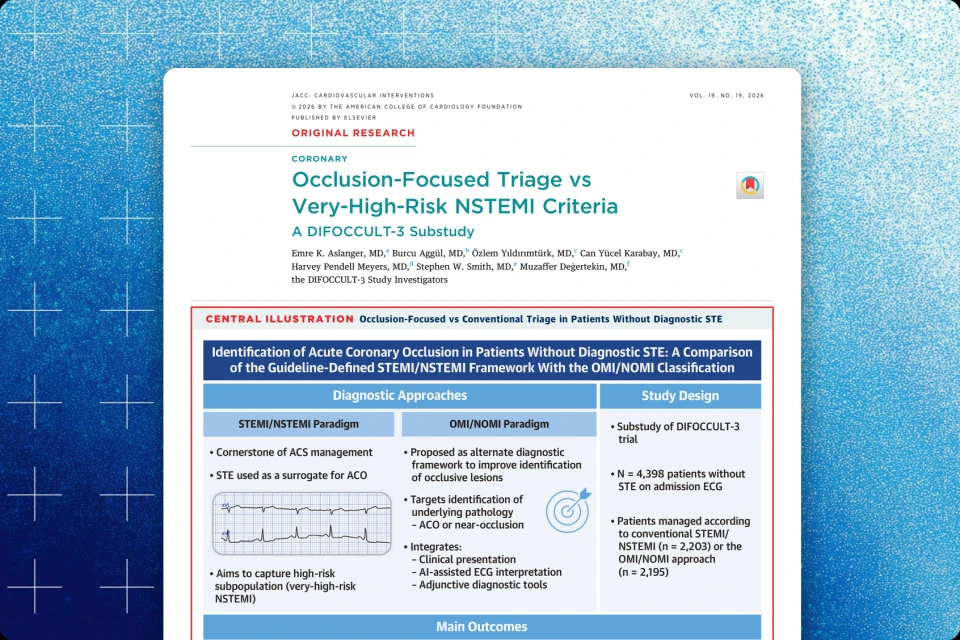
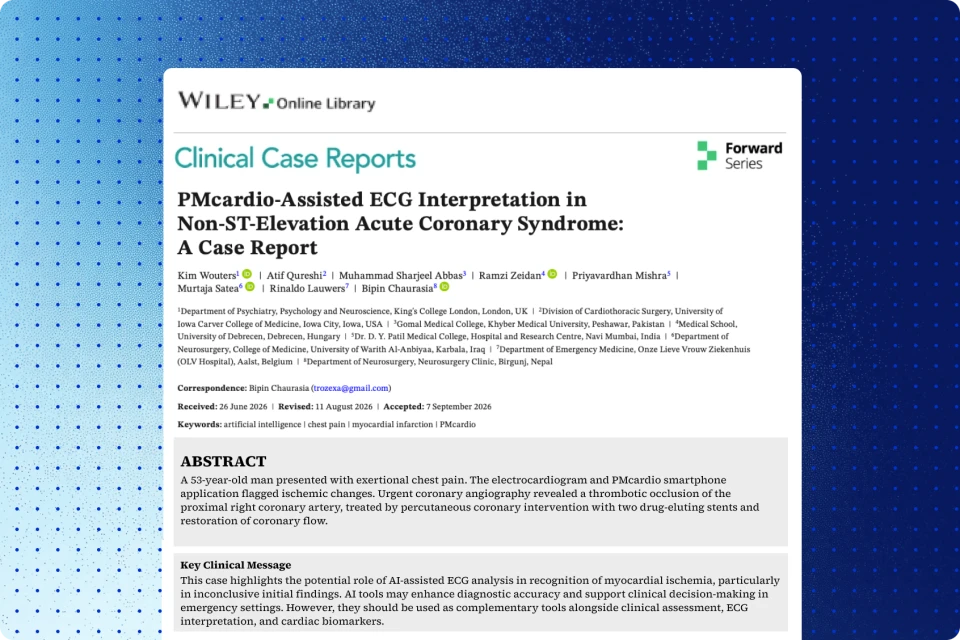
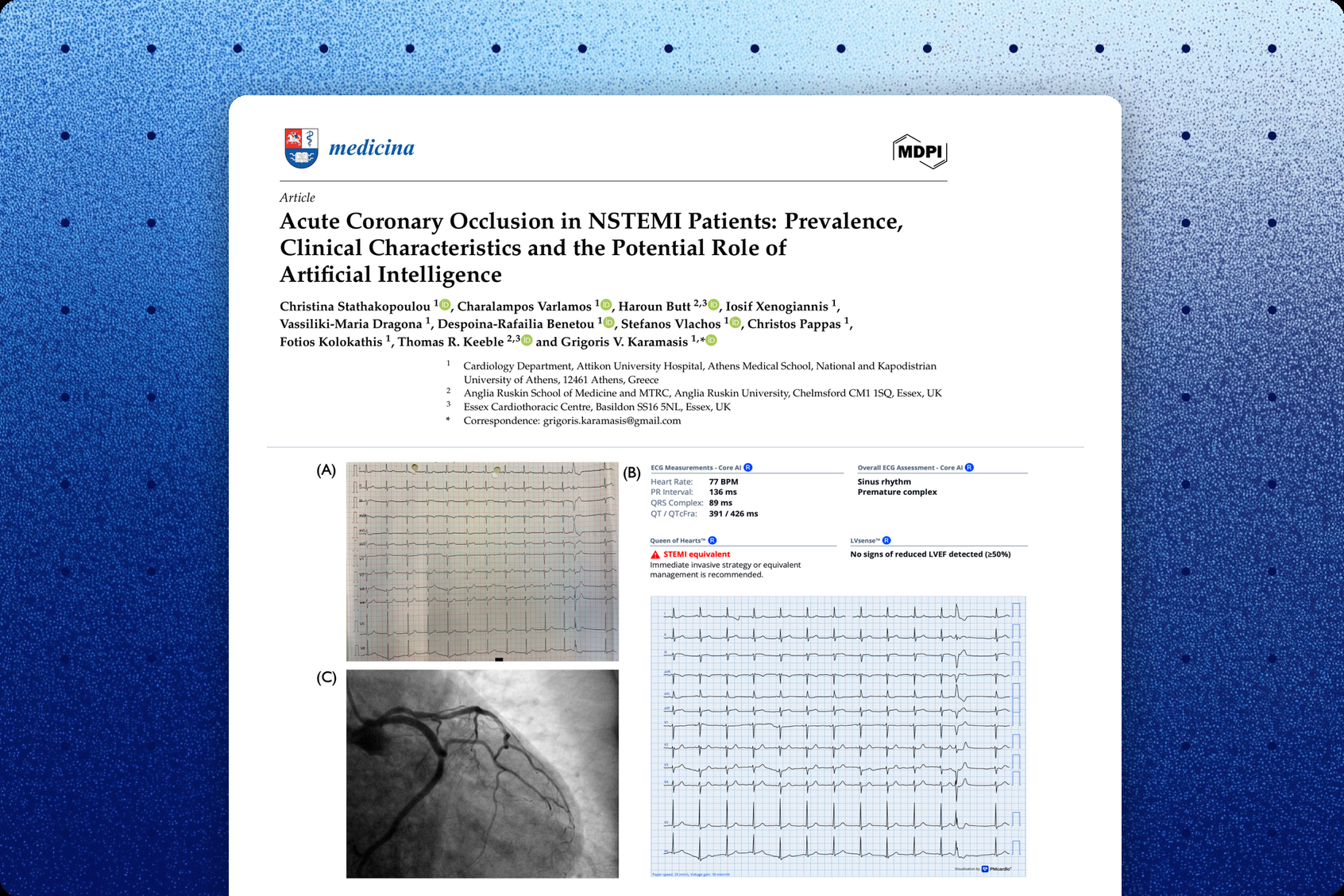
Patients classified as NSTEMI can still have an acutely occluded culprit artery, which the traditional STEMI/NSTEMI ECG classification often misses. This single-center retrospective study at Attikon University Hospital in Athens reviewed 520 consecutive NSTEMI patients who underwent coronary angiography between September 2022 and December 2024 and found that 49 (9.4%) had acute coronary occlusion (ACO), strictly defined as a culprit lesion with TIMI 0 flow; 15.7% had TIMI flow grade 0/1. When the admission ECGs of 42 ACO patients were analyzed retrospectively with the Queen of Hearts v2 AI module in PMcardio v2.5, 57.1% were classified as requiring immediate invasive management. Counting ECGs with AI-detected reduced ejection fraction as well, 73.8% of ACO patients had findings that would support expedited referral to the catheterization laboratory.
Key findings
- Of 520 consecutive NSTEMI patients undergoing coronary angiography, 49 (9.4%) had acute coronary occlusion defined strictly as a TIMI 0 culprit lesion; including TIMI 1 flow, 15.7% had TIMI flow grade 0/1.
- Queen of Hearts classified 57.1% of the 42 available admission ECGs from ACO patients as requiring immediate invasive management (2.4% STEMI, 31.0% STEMI-equivalent, 23.8% high-risk NSTEMI).
- Among ACO ECGs not flagged for immediate invasive management, 38.9% showed AI-detected reduced LVEF (<40%), so 73.8% of ACO patients had an AI finding supporting expedited catheterization lab referral.
- ACO patients were younger (60.9 vs 66.3 years; OR 0.96 per year, 95% CI 0.93–0.99), were revascularized more often (93.9% vs 82.2%), and most often had the left circumflex artery as the culprit vessel (49.0%).
Published in: Medicina
Published on: 7 May 2026
Background
The ECG-based STEMI/NSTEMI classification determines the urgency of invasive management in acute myocardial infarction, yet it often underestimates the presence of acute coronary occlusion (ACO) in patients presenting with NSTEMI, who then face delayed invasive management and worse outcomes. AI-assisted ECG interpretation has emerged as a potential tool to improve early recognition of ACO. This study aimed to determine the prevalence of ACO among NSTEMI patients, compare clinical characteristics of patients with and without ACO, and explore the potential role of AI in earlier recognition of ACO.
Methods
The authors analyzed the prospective catheterization laboratory database of Attikon University Hospital (Athens, Greece), including all consecutive adult NSTEMI patients who underwent coronary angiography between September 2022 and December 2024. Unlike studies that used TIMI flow grades 0–1, 0–2 or 0–3, ACO was defined strictly as a culprit lesion with TIMI flow grade 0 at index angiography. Baseline, clinical and angiographic characteristics were compared between ACO and non-ACO patients, with multivariable logistic regression to identify factors independently associated with ACO. Admission 12-lead ECGs of ACO patients were retrospectively analyzed with PMcardio v2.5 (Queen of Hearts v2 module), which classified each ECG as STEMI, STEMI-equivalent, high-risk NSTEMI or no STEMI and also provided an ECG-based assessment of left ventricular systolic function. STEMI, STEMI-equivalent and high-risk NSTEMI were grouped as requiring immediate invasive management.
Results
Among 520 NSTEMI patients, 49 (9.4%) had angiographically confirmed ACO; a further 6.3% of the total population had TIMI flow grade 1, so 15.7% had TIMI flow grade 0/1. ACO patients were younger (60.9 ± 12.8 vs 66.3 ± 12.0 years, p = 0.0065) and less often had dyslipidemia (38.8% vs 53.9%, p = 0.043), with no other differences in baseline characteristics. Revascularization was performed more often in the ACO group (93.9% vs 82.2%, p = 0.037), and culprit vessel distribution differed markedly (p < 0.0001): the left circumflex artery predominated in ACO (49.0%), the left anterior descending artery in non-ACO patients (52.3%). In-hospital mortality was low and similar (2.0% vs 3.0%, p > 0.99). In multivariable analysis, only age was independently associated with ACO (OR 0.96, 95% CI 0.93–0.99, p = 0.007). Admission ECGs were available for 42 of the 49 ACO patients: the AI model classified 2.4% as STEMI, 31.0% as STEMI-equivalent, 23.8% as high-risk NSTEMI and 42.9% as no STEMI, so 57.1% were identified as requiring immediate invasive management. Of the remaining ECGs, 38.9% showed AI-detected reduced LVEF (<40%), bringing to 73.8% the share of ACO patients with either an indication for immediate invasive management or significantly impaired left ventricular function. Because the AI analysis was limited to ACO cases, specificity was not assessed, and the authors describe these findings as exploratory and hypothesis-generating.
Conclusion
A significant proportion of NSTEMI patients have acute coronary occlusion, highlighting the limitations of the traditional STEMI/NSTEMI classification. AI-assisted ECG interpretation may support earlier identification of ACO, although its clinical impact requires further validation in prospective multicenter studies.
Share this article



About PMcardio
PMcardio is the market leader in AI-powered diagnostics, addressing the world’s leading cause of death – cardiovascular diseases. The innovative clinical assistant empowers healthcare professionals to detect up to 40 cardiovascular diseases. In the form of a smartphone application, the certified Class IIb medical device interprets any 12-lead ECG image in under 5 seconds to provide accurate diagnoses and individualized treatment recommendations tailored to each patient.

About Powerful Medical
Powerful Medical leads one of the most important shifts in modern medicine by augmenting human-made clinical decisions with artificial intelligence. Our primary focus is on cardiovascular diseases, the world’s leading cause of death.
Established in 2017, Powerful Medical has embarked on a mission to revolutionize the diagnosis and treatment of cardiovascular diseases. We are a medical company backed by 28 world-class cardiologists and led by our expert Scientific Board with decades of experience in daily patient care, clinical research, and medical devices. The results of our research are implemented, developed, certified, and brought to market by our 50+ strong interdisciplinary team of physicians, data scientists, AI experts, software engineers, regulatory specialists, and commercial teams.