
Acute coronary occlusion in chest pain patients with broad QRS complex – artificial intelligence-enhanced ECG interpretation compared to conventional electrocardiographic criteria
Overview
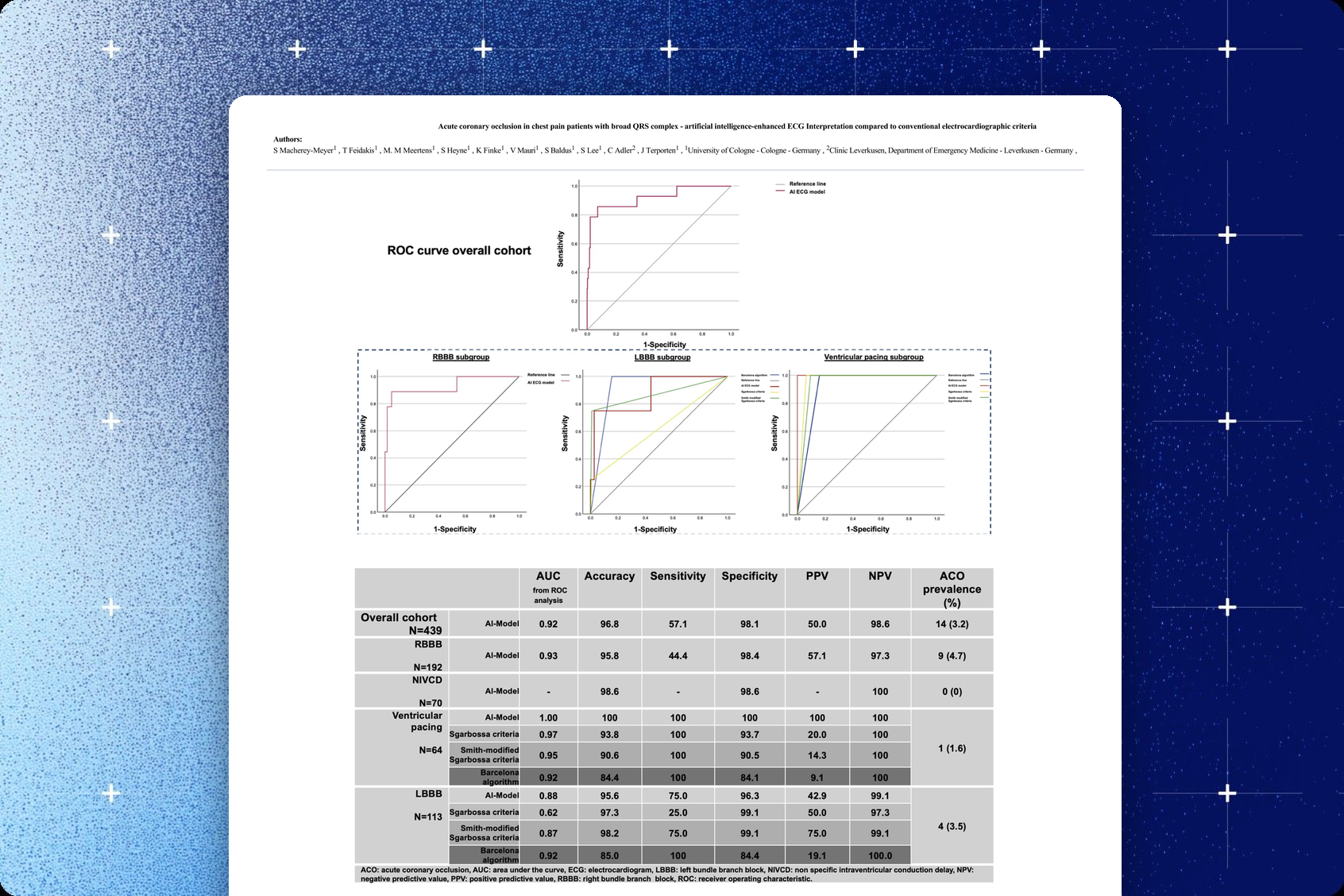
Recognising acute coronary occlusion (ACO) on the ECG is especially hard when the QRS complex is broad: criteria for left bundle branch block (LBBB) and ventricular pacing are complex, and none exist for right bundle branch block (RBBB) or non-specific intraventricular conduction delay (NIVCD). This independent single-centre study from the University of Cologne tested an AI-enhanced ECG model in 439 consecutive chest pain patients with QRS ≥120 ms, of whom 14 (3.2%) had ACO. The AI model detected 8 of 14 occlusions with 98.1% specificity and an AUC of 0.92, and kept 98.4% specificity in RBBB, where no ECG reference standard exists. In LBBB it performed similarly to the Smith-modified Sgarbossa and Barcelona criteria, and in ventricular pacing it classified all patients correctly (PPV 100% vs 9.1–20.0% for conventional criteria), although the number of occlusions was small.
Key findings
- Across 439 chest pain patients with broad QRS, the AI-ECG model detected acute coronary occlusion with an AUC of 0.92, 98.1% specificity and 98.6% NPV.
- In right bundle branch block, where no established ECG criteria exist, the model reached 98.4% specificity and an AUC of 0.93 (192 patients).
- In left bundle branch block, AI performance (AUC 0.88) was similar to Smith-modified Sgarbossa (0.87) and Barcelona (0.92) criteria, and well above original Sgarbossa (0.62).
- In ventricular pacing, the AI model classified all 64 patients correctly (PPV 100%), versus a PPV of 9.1–20.0% for Sgarbossa, Smith-modified Sgarbossa and Barcelona criteria.
Published in: ESC Congress 2026 (ePoster)
Published on: 30 August 2026
Background
Identifying acute coronary occlusion (ACO) in chest pain patients with wide QRS complexes remains challenging. Electrocardiographic criteria exist for left bundle branch block (LBBB) and ventricular pacing (VP), but their complexity limits routine use, and no standardised ECG-based framework is available for right bundle branch block (RBBB) or non-specific intraventricular conduction delay (NIVCD). Artificial intelligence (AI)-enhanced ECG analysis may add value, but its performance in these subgroups is unclear. This study evaluated the diagnostic performance of an AI-enhanced ECG model for detecting ACO in chest pain patients with bundle branch block or NIVCD in a metropolitan chest pain unit, and compared it with established ECG criteria in LBBB and VP.
Methods
The AI model, a deep convolutional neural network, was previously trained and externally validated in international cohorts. All consecutive chest pain patients presenting to the chest pain unit of the University of Cologne, Germany, between November 2018 and June 2021 with a QRS duration ≥120 ms were included. ECGs were independently classified by two investigators, with adjudication by a third if needed, and clinical management followed European Society of Cardiology guidelines. The endpoint was ACO, adjudicated by an independent, blinded physician using coronary angiography, biomarkers and echocardiography. Diagnostic performance was assessed by receiver operating characteristic (ROC) analysis. In LBBB and VP, the AI model was compared with the Sgarbossa, Smith-modified Sgarbossa and Barcelona criteria.
Results
Of 439 patients (median QRS 144 ms [132–158]), 192 had RBBB (43.7%), 113 LBBB (25.7%), 70 NIVCD (15.9%) and 64 VP (14.6%). ACO prevalence was 3.2% (14 patients: 9 RBBB, 4 LBBB, 1 VP). Overall, the AI model detected 8 of 14 ACO cases (sensitivity 57.1%) with an AUC of 0.92, specificity of 98.1%, accuracy of 96.8%, PPV of 50.0% and NPV of 98.6%, and produced two false positives in the low-risk subgroup (n = 216). In RBBB, the model reached an AUC of 0.93, specificity of 98.4% and sensitivity of 44.4%; in NIVCD, where no ACO occurred, specificity was 98.6%. In VP, the AI model classified all patients correctly (AUC 1.00, PPV 100%), whereas the Sgarbossa, Smith-modified Sgarbossa and Barcelona criteria detected the single ACO case but had PPVs of 20.0%, 14.3% and 9.1%. In LBBB, the AI model (AUC 0.88; sensitivity 75.0%, specificity 96.3%) performed similarly to the Smith-modified Sgarbossa (AUC 0.87; 75.0%, 99.1%) and Barcelona criteria (AUC 0.92; 100%, 84.4%), and better than the original Sgarbossa criteria (AUC 0.62; sensitivity 25.0%).
Conclusion
The AI-enhanced ECG model showed high specificity in patients with RBBB, a subgroup with no established ECG reference standard, which warrants further evaluation in independent cohorts. In LBBB, it achieved diagnostic performance comparable to established but complex ECG criteria, and in ventricular pacing it showed superior classification accuracy. Subject to external validation in cohorts with a higher prevalence of ACO, this approach may offer a rapid and pragmatic diagnostic alternative.
Share this article



About PMcardio
PMcardio is the market leader in AI-powered diagnostics, addressing the world’s leading cause of death – cardiovascular diseases. The innovative clinical assistant empowers healthcare professionals to detect up to 40 cardiovascular diseases. In the form of a smartphone application, the certified Class IIb medical device interprets any 12-lead ECG image in under 5 seconds to provide accurate diagnoses and individualized treatment recommendations tailored to each patient.

About Powerful Medical
Powerful Medical leads one of the most important shifts in modern medicine by augmenting human-made clinical decisions with artificial intelligence. Our primary focus is on cardiovascular diseases, the world’s leading cause of death.
Established in 2017, Powerful Medical has embarked on a mission to revolutionize the diagnosis and treatment of cardiovascular diseases. We are a medical company backed by 28 world-class cardiologists and led by our expert Scientific Board with decades of experience in daily patient care, clinical research, and medical devices. The results of our research are implemented, developed, certified, and brought to market by our 50+ strong interdisciplinary team of physicians, data scientists, AI experts, software engineers, regulatory specialists, and commercial teams.