
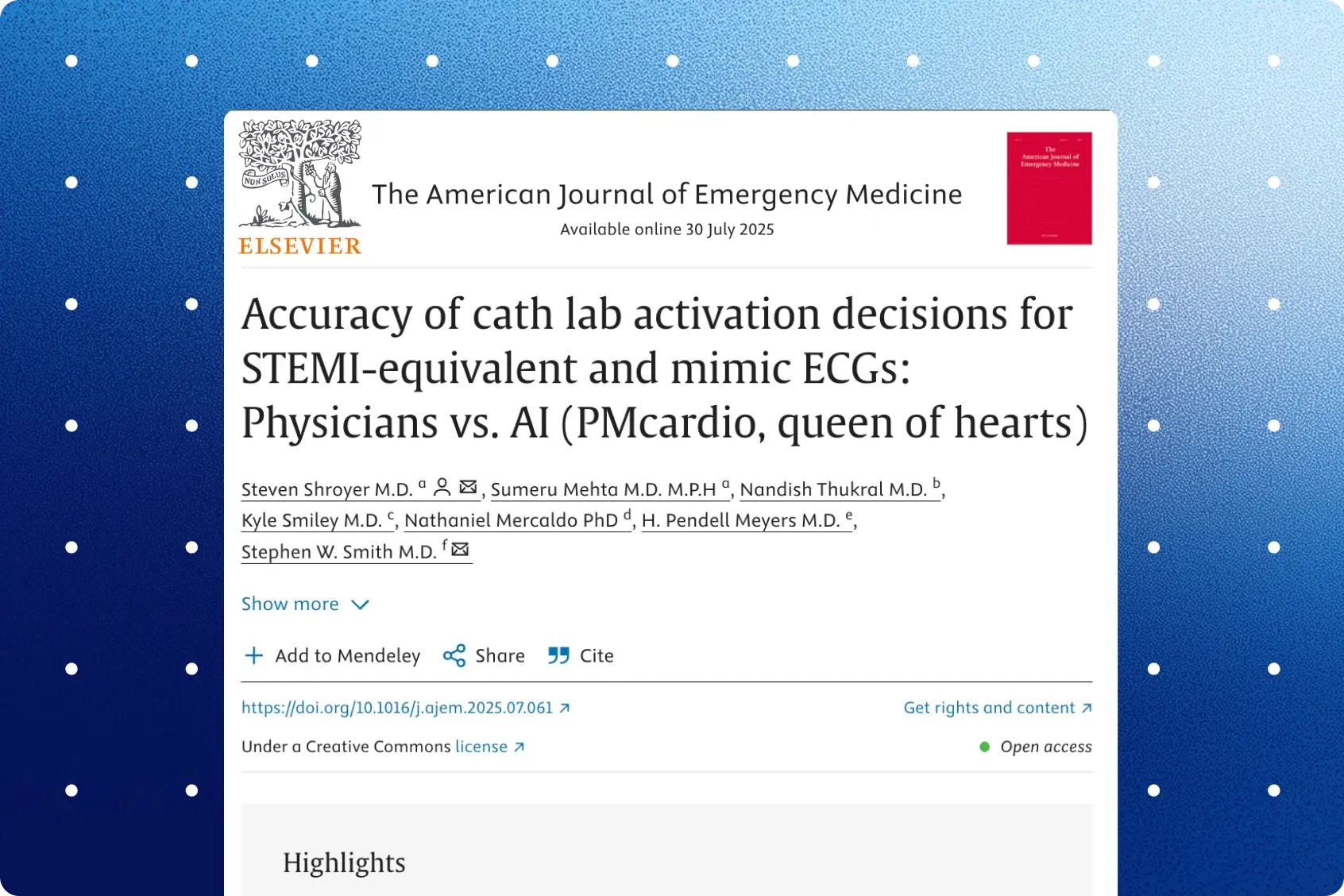
Accuracy of cath lab activation decisions for STEMI-equivalent and mimic ECGs: Physicians vs. AI (PMcardio, queen of hearts)
Overview
This study aimed to measure physician accuracy for interpreting STEMI-equivalent and STEMI-mimic ECGs for catheterization laboratory activation (CLA) and compare their performance to a machine learning-based artificial intelligence algorithm, Queen of Hearts AI (QoH AI).
Key findings
- 53 emergency physicians and 42 cardiologists interpreted 18 challenging ECGs.
- Compared cath-lab activation accuracy against Queen of Hearts AI.
- Targets STEMI-equivalent and mimic patterns prone to misclassification.
Published in: The American Journal of Emergency Medicine
Published on: 30 July 2025
Background
Accurate ECG interpretation is crucial to identify occlusive myocardial infarction (OMI) to determine the need for immediate catheterization laboratory activation (CLA). STEMI-equivalent and STEMI-mimic ECG patterns deviate from conventional STEMI criteria, risking misclassification of OMI cases. The diagnostic accuracy for these complex ECGs is unknown.
Methods
Fifty-three EPs and 42 cardiologists interpreted 18 ECGs (eight STEMI-equivalents, eight STEMI-mimics, with one STEMI, and a normal ECG as controls) to determine the presence of OMI requiring immediate CLA. The same ECGs were analyzed by QoH AI. Interpretations were compared against a reference standard based on angiography, troponin, echocardiography, and clinical follow-up.
Results
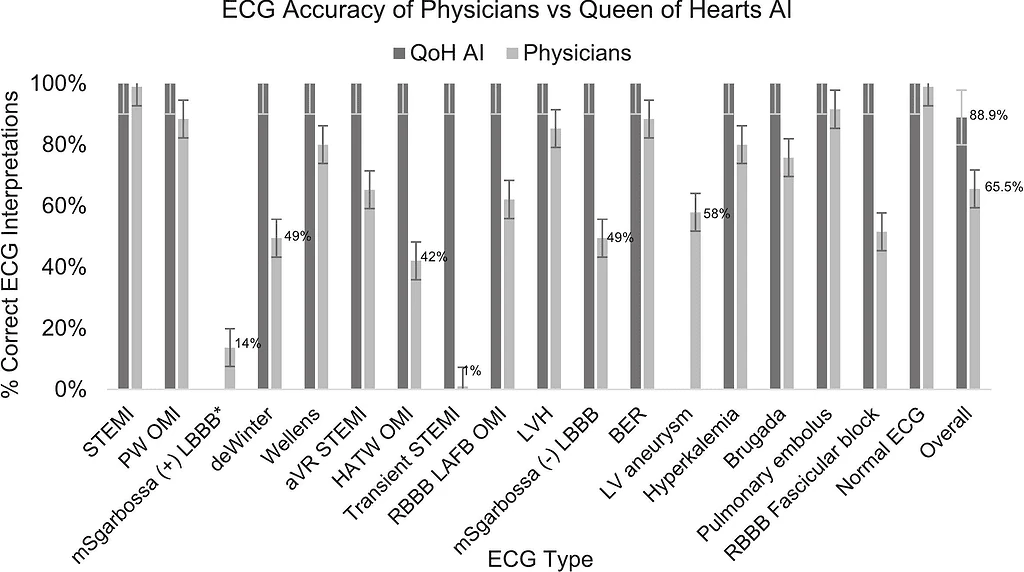
Interpretation accuracies were similar between EPs and cardiologists (65.6 %, 95 % CI [51, 78]; 65.5 %, 95 % CI [51, 77], respectively; p = 0.969), and significantly lower than QoH AI (88.9 %, 95 % CI [82, 93]) vs. physicians overall, 65.6 %, 95 % CI [52, 77]; p < 0.001). Physicians most frequently misclassified de Winter, Transient STEMI, Hyperacute T-wave OMI, and bundle branch block ECGs. QoH AI only misclassified left bundle branch block with OMI and left ventricular aneurysm without OMI.
Conclusion
Physicians frequently misinterpret STEMI-equivalent and STEMI-mimic ECGs, potentially impacting CLA decisions. QoH AI demonstrated superior accuracy, suggesting a potential to reduce missed OMIs and unnecessary catheterization laboratory activations. Prospective studies are needed to validate these findings in clinical practice.
Authors: Steven Shroyer M.D., Sumeru Mehta M.D. M.P.H, Nandish Thukral M.D.,
Kyle Smiley M.D., Nathaniel Mercaldo PhD, H. Pendell Meyers M.D., Stephen W. Smith M.D.
Share this article



About PMcardio
PMcardio is the market leader in AI-powered diagnostics, addressing the world’s leading cause of death – cardiovascular diseases. The innovative clinical assistant empowers healthcare professionals to detect up to 40 cardiovascular diseases. In the form of a smartphone application, the certified Class IIb medical device interprets any 12-lead ECG image in under 5 seconds to provide accurate diagnoses and individualized treatment recommendations tailored to each patient.

About Powerful Medical
Powerful Medical leads one of the most important shifts in modern medicine by augmenting human-made clinical decisions with artificial intelligence. Our primary focus is on cardiovascular diseases, the world’s leading cause of death.
Established in 2017, Powerful Medical has embarked on a mission to revolutionize the diagnosis and treatment of cardiovascular diseases. We are a medical company backed by 28 world-class cardiologists and led by our expert Scientific Board with decades of experience in daily patient care, clinical research, and medical devices. The results of our research are implemented, developed, certified, and brought to market by our 50+ strong interdisciplinary team of physicians, data scientists, AI experts, software engineers, regulatory specialists, and commercial teams.