
Deep-learning Assisted ECG-based Emergent Cathlab Activation: First Prospective Implementation of a Smartphone-based System
Overview
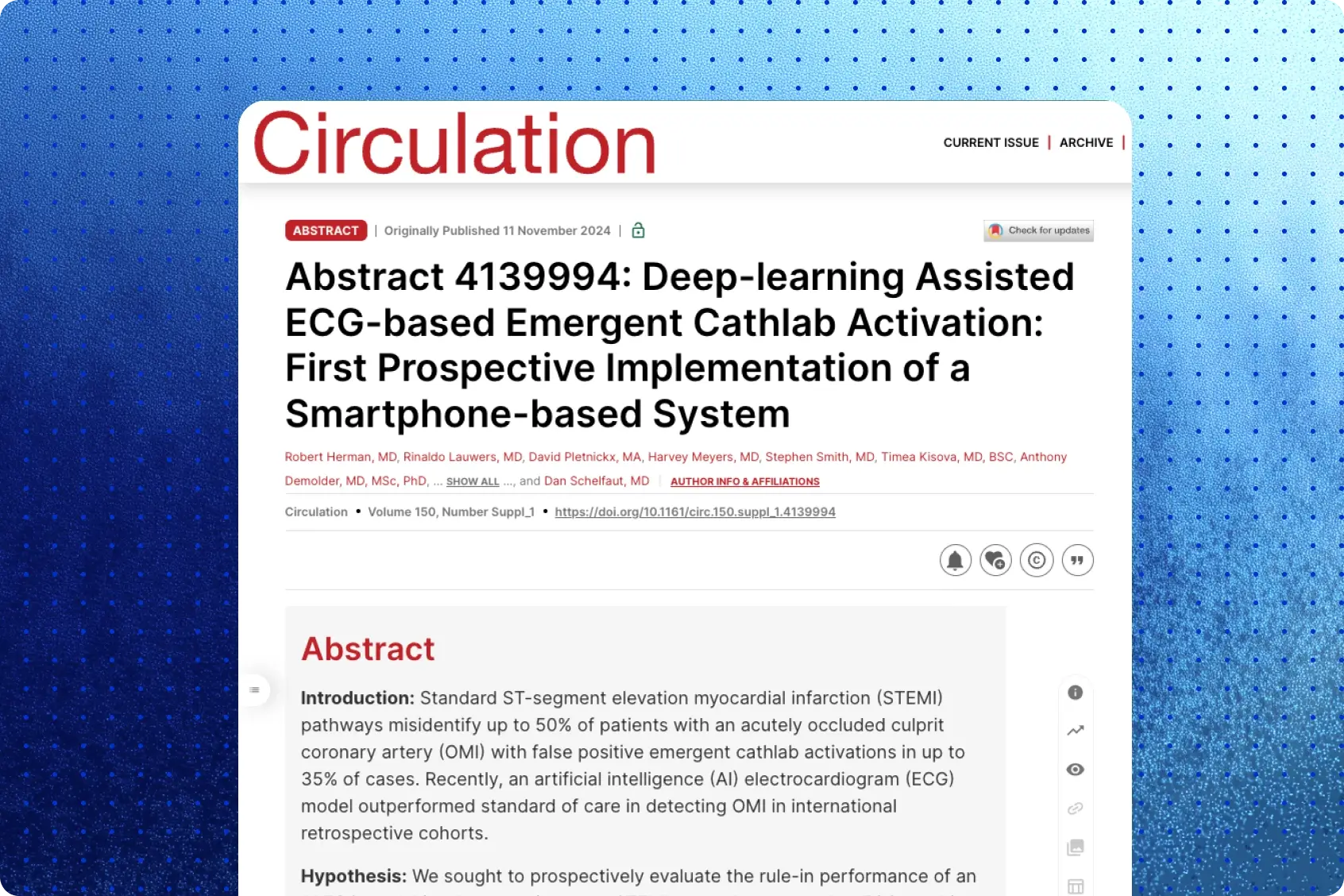
In its first prospective performance evaluation, the PMcardio STEMI AI ECG Model outperformed standard ECG machine readings, detecting high-risk coronary blockage with 95.7% sensitivity vs. 47.8%. By correctly flagging 15 initially missed patients, the AI model demonstrated its potential to strengthen triage accuracy and accelerate life-saving decisions.
Key findings
- First prospective implementation of the smartphone-based AI system.
- 95.7% sensitivity vs 47.8% for standard ECG machine readings.
- Correctly flagged 15 initially missed patients.
Published in: Circulation (AHA Journals) – presented at the American Heart Association (AHA) 2024 Scientific Sessions Presented Date: November 11, 2024
Background
Standard ST-segment elevation myocardial infarction (STEMI) pathways misidentify up to 50% of patients with an acutely occluded culprit coronary artery (OMI) with false positive emergent cathlab activations in up to 35% of cases. Recently, an artificial intelligence (AI) electrocardiogram (ECG) model outperformed standard of care in detecting OMI in international retrospective cohorts.
We sought to prospectively evaluate the rule-in performance of an AI ECG model in a large tertiary care STEMI network compared to ECG machine readings of STEMI and AI-assisted emergency physicians.
Methods
An AI model trained to detect acute coronary occlusion regardless of ST elevation was implemented using smartphones in a tertiary care STEMI network consisting of 1 hub hospital, 1 spoke center, and 2 emergency medical service crews (EMS) (Fig 1A). Outcomes of all patients presenting with atraumatic chest pain during a 10-week period between January and March 2024 were adjudicated using ECG, laboratory, and angiographic chart review and classified based on the presence of OMI.
Results
A total of 731 consecutive patients (68% male) with atraumatic chest pain were included; 142 patients were hospitalized of whom 23 (16%) met the primary outcome of OMI. The AI model showed a significantly higher sensitivity detecting OMI as compared to ECG machine (95.7% vs. 47.8%, p<0.001, Fig 1B) at comparable specificity (95% vs. 96%, respectively) with overall superior predictive accuracy (Chi-squared=8.1; p=0.004). The AI model correctly identified 15 cases that the ECG machine misclassified (80% were false negatives by ECG machine). All AI false positives were patients post recent myocardial infarction or angioplasty. Sensitivity of AI-assisted emergency physicians interpreting OMI was 78.2% indicating potential instances of AI underutilization.
Conclusion
This first prospective performance evaluation in a large all-comer atraumatic chest pain cohort indicates high accuracy of unbiased, AI-powered ECG detecting acute coronary occlusion. The findings suggest its potential to improve ACS patient outcomes through timely referral for invasive management in a real-world clinical setting.
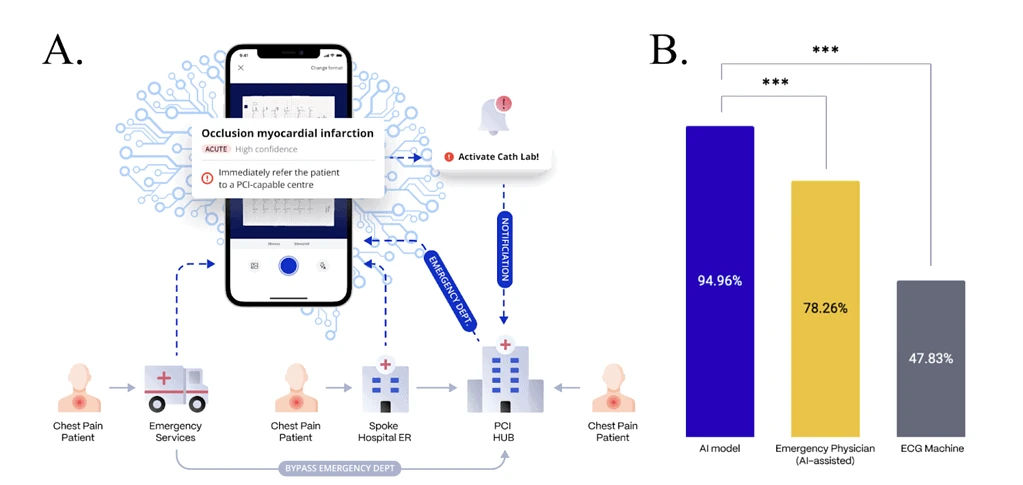
Panel A shows an implementation of an AI-powered ECG model detecting acute coronary occlusion in a STEMI network. Panel B compares the sensitivity of the AI model, the emergency physician (AI-assisted), and the ECG machine at equal specificity.
Share this article



About PMcardio
PMcardio is the market leader in AI-powered diagnostics, addressing the world’s leading cause of death – cardiovascular diseases. The innovative clinical assistant empowers healthcare professionals to detect up to 40 cardiovascular diseases. In the form of a smartphone application, the certified Class IIb medical device interprets any 12-lead ECG image in under 5 seconds to provide accurate diagnoses and individualized treatment recommendations tailored to each patient.

About Powerful Medical
Powerful Medical leads one of the most important shifts in modern medicine by augmenting human-made clinical decisions with artificial intelligence. Our primary focus is on cardiovascular diseases, the world’s leading cause of death.
Established in 2017, Powerful Medical has embarked on a mission to revolutionize the diagnosis and treatment of cardiovascular diseases. We are a medical company backed by 28 world-class cardiologists and led by our expert Scientific Board with decades of experience in daily patient care, clinical research, and medical devices. The results of our research are implemented, developed, certified, and brought to market by our 50+ strong interdisciplinary team of physicians, data scientists, AI experts, software engineers, regulatory specialists, and commercial teams.