
Can an AI ECG algorithm improve diagnostic accuracy for acute coronary occlusion in the difficult subset of canceled catheterization lab activations?
Overview
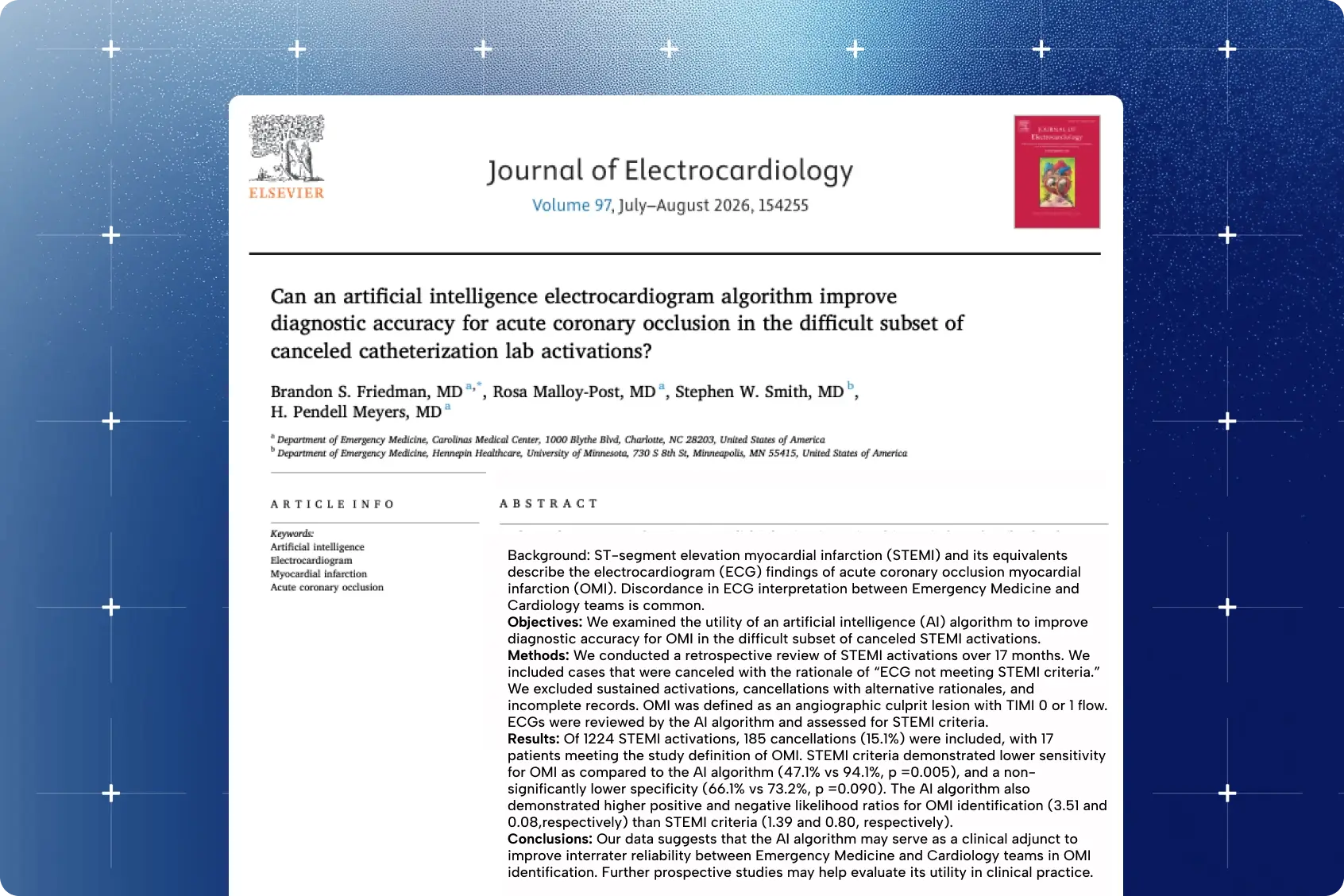
Discordance in ECG interpretation between Emergency Medicine and Cardiology teams is common, and within canceled STEMI activations, a true acute coronary occlusion myocardial infarction (OMI) can go unrecognized. This retrospective study examined whether an AI ECG algorithm (Queen of Hearts™) could improve OMI detection in this difficult subset. Across three referral centers, the investigators analyzed 185 activations canceled for not meeting STEMI criteria, of which 17 met the definition of a missed OMI. The AI algorithm identified 16 of 17 cases, far exceeding STEMI criteria in sensitivity (94.1% vs. 47.1%), supporting its use as an adjunct to clinical judgment in ambiguous cases.
Key findings
- 185 activations canceled for not meeting STEMI criteria (three centers).
- AI identified 16 of 17 missed occlusion MIs.
- 94.1% sensitivity vs 47.1% for STEMI criteria.
Published in: Journal of Electrocardiology
Published on: 01 June 2026
Background
ST-segment elevation myocardial infarction (STEMI) and its equivalents describe the electrocardiogram (ECG) findings of acute coronary occlusion myocardial infarction (OMI). Discordance in ECG interpretation between Emergency Medicine and Cardiology teams is common.
Methods
We conducted a retrospective review of STEMI activations over 17 months. We included cases that were canceled with the rationale of “ECG not meeting STEMI criteria.” We excluded sustained activations, cancellations with alternative rationales, and incomplete records. OMI was defined as an angiographic culprit lesion with TIMI 0 or 1 flow. ECGs were reviewed by the AI algorithm and assessed for STEMI criteria.
Results
Of 1224 STEMI activations, 185 cancellations (15.1%) were included, with 17 patients meeting the study definition of OMI. STEMI criteria demonstrated lower sensitivity for OMI as compared to the AI algorithm (47.1% vs 94.1%, p = 0.005), and a non-significantly lower specificity (66.1% vs 73.2%, p = 0.090). The AI algorithm also demonstrated higher positive and negative likelihood ratios for OMI identification (3.51 and 0.08, respectively) than STEMI criteria (1.39 and 0.80, respectively).
Conclusion
Our data suggests that the AI algorithm may serve as a clinical adjunct to improve interrater reliability between Emergency Medicine and Cardiology teams in OMI identification. Further prospective studies may help evaluate its utility in clinical practice.
Share this article



About PMcardio
PMcardio is the market leader in AI-powered diagnostics, addressing the world’s leading cause of death – cardiovascular diseases. The innovative clinical assistant empowers healthcare professionals to detect up to 40 cardiovascular diseases. In the form of a smartphone application, the certified Class IIb medical device interprets any 12-lead ECG image in under 5 seconds to provide accurate diagnoses and individualized treatment recommendations tailored to each patient.

About Powerful Medical
Powerful Medical leads one of the most important shifts in modern medicine by augmenting human-made clinical decisions with artificial intelligence. Our primary focus is on cardiovascular diseases, the world’s leading cause of death.
Established in 2017, Powerful Medical has embarked on a mission to revolutionize the diagnosis and treatment of cardiovascular diseases. We are a medical company backed by 28 world-class cardiologists and led by our expert Scientific Board with decades of experience in daily patient care, clinical research, and medical devices. The results of our research are implemented, developed, certified, and brought to market by our 50+ strong interdisciplinary team of physicians, data scientists, AI experts, software engineers, regulatory specialists, and commercial teams.