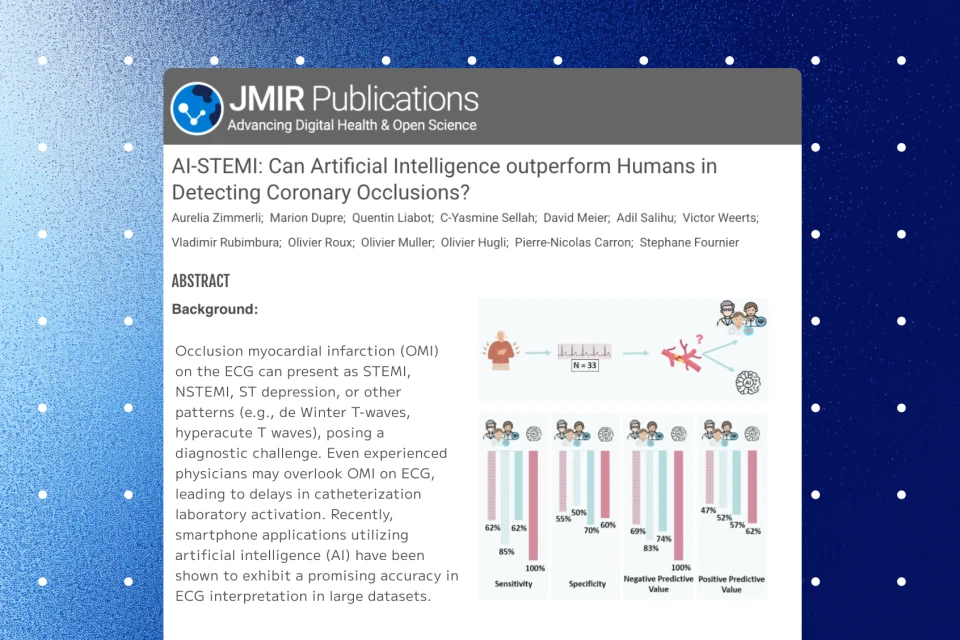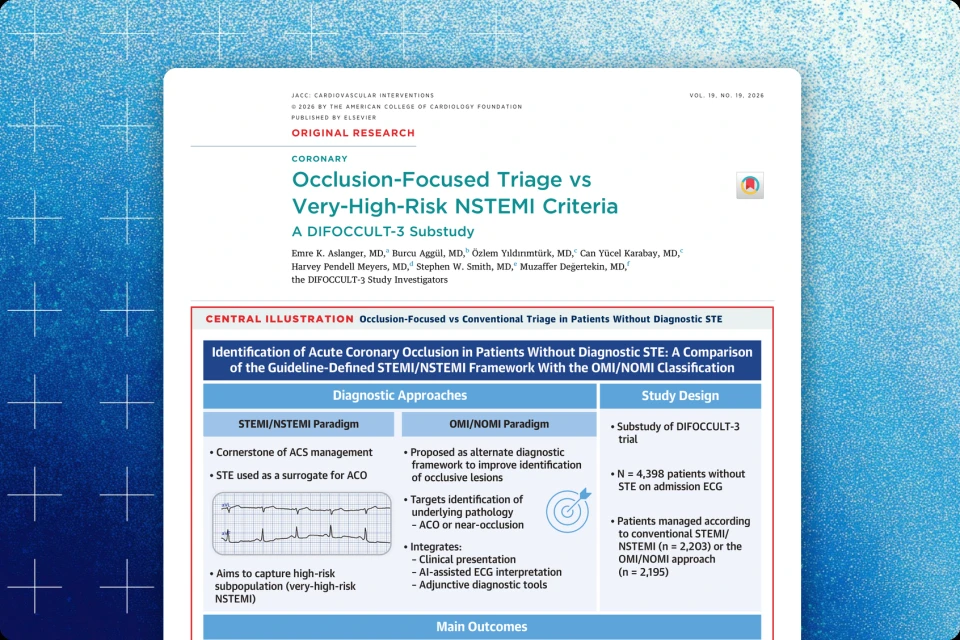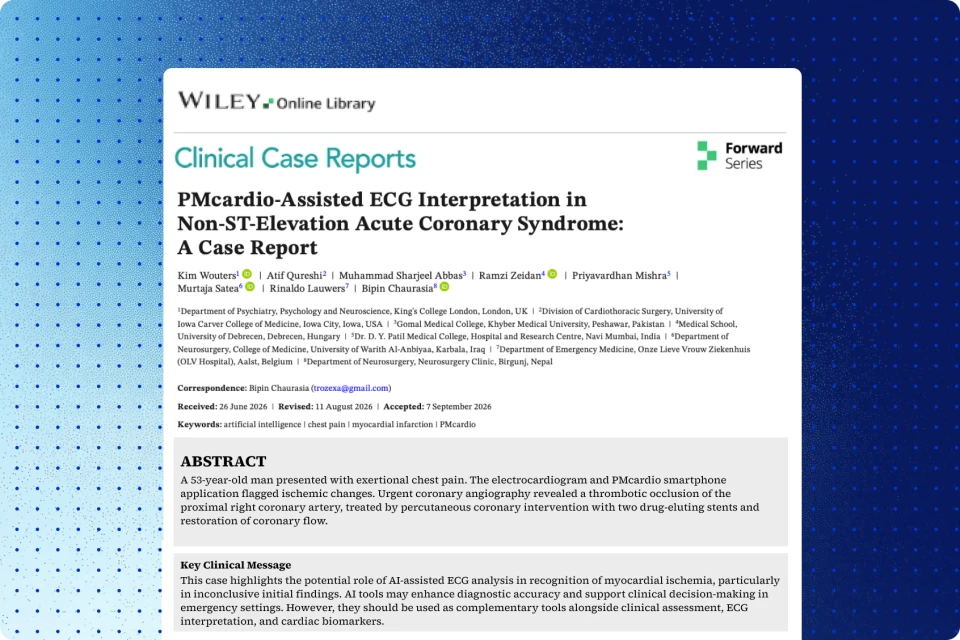

Single Center Retrospective Validation of an Artificial Intelligence ECG Model Detecting Acute Coronary Occlusion
Overview
In this single-center US-based cohort study of emergency department patients with suspected heart attacks, the PMcardio STEMI AI ECG Model outperformed standard STEMI criteria, improving detection sensitivity by 30%. Patients correctly identified by AI but missed by cardiologists faced notable treatment delays (~22 hours), underscoring the AI’s potential to enable faster diagnosis and earlier intervention.
Key findings
- Improved acute coronary occlusion detection sensitivity by 30% vs STEMI criteria.
- Patients missed by cardiologists faced ~22-hour treatment delays.
- Single-center US emergency department validation.
Published in: Heart Rhythm Presented Date: May 16, 2024
Background
STEMI criteria have low sensitivity to detect acute coronary occlusion myocardial infarction (OMI). The Queen of Hearts (QOH) is an artificial intelligence (AI) model developed by Powerful Medical (Bratislava, Slovakia) which has been shown to outperform STEMI criteria for detection of OMI. Performance in all-comer chest pain populations is not known.
We evaluated QOH in our center in consecutive patients presenting to the emergency department (ED) with suspected acute coronary syndrome (ACS).
Methods
We reviewed patients who presented to our ED in October 2023 with suspected ACS. We included patients who ruled out by serial troponin or underwent angiography. Primary outcome of OMI was defined as culprit artery with TIMI flow 0-2 or culprit artery with TIMI flow 3 and high sensitivity troponin I > 5000 ng/L. Secondary outcome was door-to-device time (D2D). QOH outputs an AI interpretation (OMI or not OMI) and confidence level (low, mid, or high).
We considered OMI with mid or high confidence to be positive. For cardiologist over-read, we considered “acute MI” to be positive. We compared sensitivity using Fisher’s exact test, specificity and accuracy using Chi square, and D2D using Student’s t-test.
Results
Among 528 patients, 498 (94.3%) ruled out and 31 (17.0%) had angiography. OMI outcome was met in 10 (1.9%) and was not met in 518 (98.1%). Comparing QOH to cardiologist over-read, sensitivity was 70% vs 40%, (p=0.18), specificity was 99.2% vs 99.4% (p=NS), and accuracy was 98.7% vs 98.3% (p=0.6), respectively. For patients with QOH and cardiologist positive ECG, mean D2D was 86 ± 21 minutes. For patients with QOH positive and cardiologist negative ECG, mean D2D was 1358 ± 452 minutes (p=0.0021).
Conclusion
In our center, QOH ECG interpretation improved sensitivity for OMI by 30% without loss of specificity. QOH could expedite identification of OMI for early intervention.
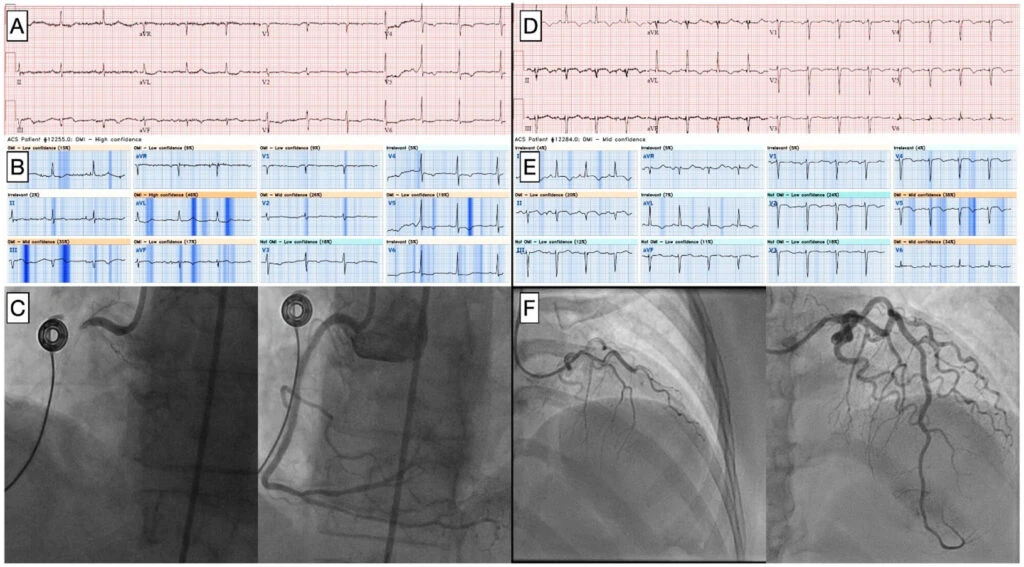
A: ECG for 81 year old woman with chest pain, negative by cardiologist. B: OMI high confidence by QOH. C: Angiography before and after PCI to RCA. D: ECG for 58 year old woman with chest pain, negative by cardiologist. E: OMI mid confidence by QOH. F: Angiography before and after PCI to LAD.
Share this article



About PMcardio
PMcardio is the market leader in AI-powered diagnostics, addressing the world’s leading cause of death – cardiovascular diseases. The innovative clinical assistant empowers healthcare professionals to detect up to 40 cardiovascular diseases. In the form of a smartphone application, the certified Class IIb medical device interprets any 12-lead ECG image in under 5 seconds to provide accurate diagnoses and individualized treatment recommendations tailored to each patient.

About Powerful Medical
Powerful Medical leads one of the most important shifts in modern medicine by augmenting human-made clinical decisions with artificial intelligence. Our primary focus is on cardiovascular diseases, the world’s leading cause of death.
Established in 2017, Powerful Medical has embarked on a mission to revolutionize the diagnosis and treatment of cardiovascular diseases. We are a medical company backed by 28 world-class cardiologists and led by our expert Scientific Board with decades of experience in daily patient care, clinical research, and medical devices. The results of our research are implemented, developed, certified, and brought to market by our 50+ strong interdisciplinary team of physicians, data scientists, AI experts, software engineers, regulatory specialists, and commercial teams.