
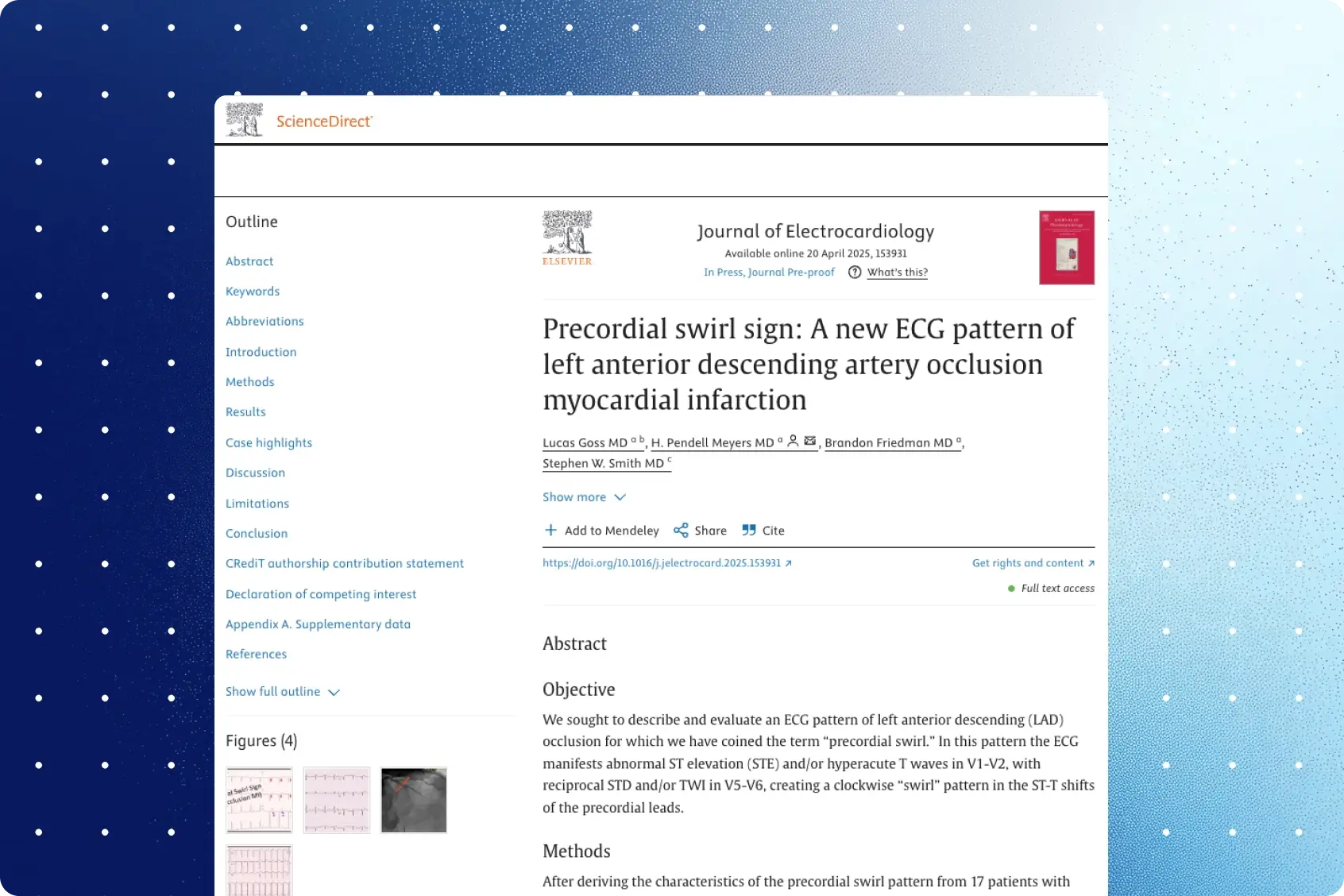
Precordial Swirl Sign: A New ECG Pattern of Left Anterior Descending Artery Occlusion Myocardial Infarction
Overview
This study identifies the novel “precordial swirl sign,” a distinct ECG pattern that can uncover critical LAD coronary artery blockages often missed by standard STEMI criteria. It offers a promising step toward earlier and more accurate detection of high-risk heart attacks.
Key findings
- Describes the novel ‘precordial swirl sign’ ECG pattern.
- Flags left anterior descending (LAD) artery occlusions.
- Catches high-risk heart attacks missed by standard STEMI criteria.
Published in: Journal of Electrocardiology
Published Date: April 20, 2025
Objective
We sought to describe and evaluate an ECG pattern of left anterior descending (LAD) occlusion for which we have coined the term “precordial swirl.” In this pattern the ECG manifests abnormal ST elevation (STE) and/or hyperacute T waves in V1-V2, with reciprocal STD and/or TWI in V5-V6, creating a clockwise “swirl” pattern in the ST-T shifts of the precordial leads.
Methods
After deriving the characteristics of the precordial swirl pattern from 17 patients with proven acute LAD occlusion, the pattern was evaluated retrospectively using a high-risk population of ED patients with possible ACS symptoms. The primary outcome measures were positive predictive value and specificity for Occlusion MI for each of the developed criteria for precordial swirl sign.
Results
Several criteria were derived based on observations and measurements of the derivation cohort. The validation cohort consisted of 808 patients, of whom 265 had Occlusion MI. Precordial swirl pattern, defined as normal QRS (narrow QRS without LVH) with STD in V5 and/or V6 plus any STE in V1 and/or V2, yielded PPV 42 %, sensitivity 11 %, (95 % CI 8–15 %), and specificity 92 % (95 % CI 90–95 %) for Occlusion MI. When defined as a narrow QRS plus STD in V5/V6 plus T wave to S wave amplitude ratio > 0.40 in V2, precordial swirl pattern yielded PPV 70 %, sensitivity 9 %, specificity 98 %. Of the 23 Occlusion MI patients correctly identified by precordial swirl sign, 19 (83 %) had LAD culprit lesions, and 16 (70 %) were missed by STEMI criteria.
Conclusion
Among high-risk ACS patients in the ED, precordial swirl sign had clinically relevant PPV and specificity for LAD Occlusion MI, including a significant number of patients who are missed by the current STEMI criteria. Further study should be done to validate these findings and improve detection of acute coronary occlusion myocardial infarction.
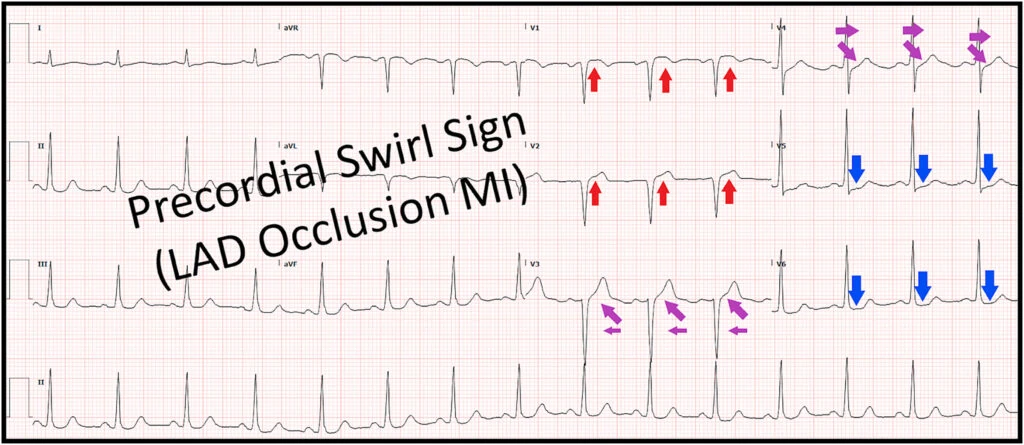
Fig. 1. Precordial Swirl example case. This ECG was obtained from a 49-year-old man with active acute chest pain. The findings highlighted in the image were all shown to be new compared to the patient’s baseline ECG. Approximately 45 min later, with ongoing pain, a repeat ECG showed clear anterior STEMI(+) OMI findings. The patient was found to have an acute thrombotic culprit lesion of the proximal LAD.
Share this article



About PMcardio
PMcardio is the market leader in AI-powered diagnostics, addressing the world’s leading cause of death – cardiovascular diseases. The innovative clinical assistant empowers healthcare professionals to detect up to 40 cardiovascular diseases. In the form of a smartphone application, the certified Class IIb medical device interprets any 12-lead ECG image in under 5 seconds to provide accurate diagnoses and individualized treatment recommendations tailored to each patient.

About Powerful Medical
Powerful Medical leads one of the most important shifts in modern medicine by augmenting human-made clinical decisions with artificial intelligence. Our primary focus is on cardiovascular diseases, the world’s leading cause of death.
Established in 2017, Powerful Medical has embarked on a mission to revolutionize the diagnosis and treatment of cardiovascular diseases. We are a medical company backed by 28 world-class cardiologists and led by our expert Scientific Board with decades of experience in daily patient care, clinical research, and medical devices. The results of our research are implemented, developed, certified, and brought to market by our 50+ strong interdisciplinary team of physicians, data scientists, AI experts, software engineers, regulatory specialists, and commercial teams.