
Performance of Artificial Intelligence Powered ECG Analysis in Suspected ST-Segment Elevation Myocardial Infarction
Overview
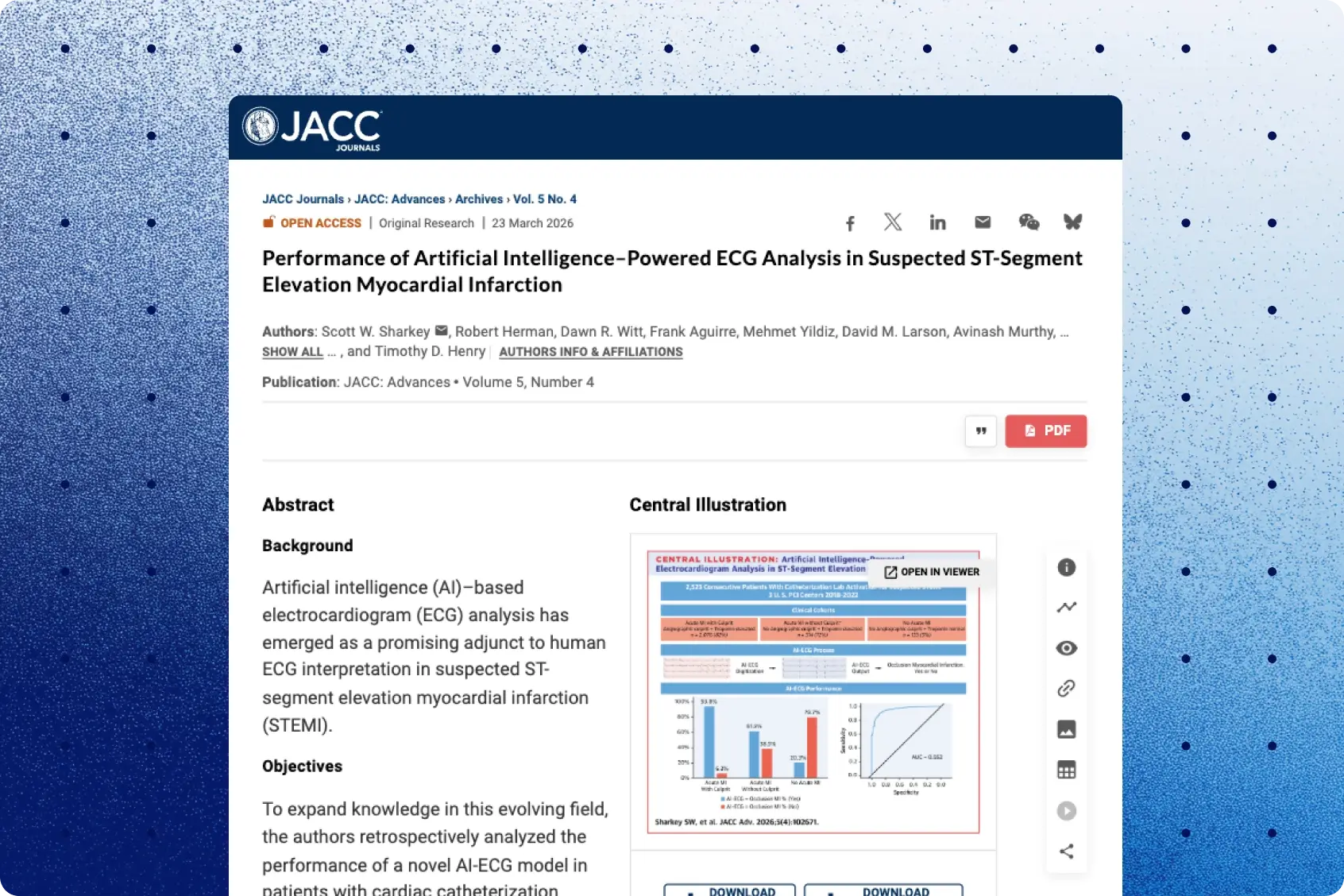
This study evaluates the real-world performance of an AI-based ECG interpretation tool for detecting STEMI in patients undergoing emergent catheterization laboratory activation, using angiographic findings as the reference standard. Compared with standard clinical ECG interpretation, the AI model achieved higher sensitivity and specificity, significantly reducing false-positive activations while maintaining strong performance even in challenging cases such as arrhythmias or conduction abnormalities. These results suggest that AI-assisted ECG analysis can improve diagnostic accuracy, optimize triage, and support faster, more appropriate decision-making in acute coronary syndrome management.
Key findings
- Real-world evaluation against an angiographic reference standard.
- Higher sensitivity and specificity than standard ECG interpretation.
- Reduced false-positive activations, even with arrhythmias/conduction issues.
Published in: JACC Advances
Published on: 23 March 2026
Background
Artificial intelligence (AI)–based electrocardiogram (ECG) analysis has emerged as a promising adjunct to human ECG interpretation in suspected ST-segment elevation myocardial infarction (STEMI).
Methods
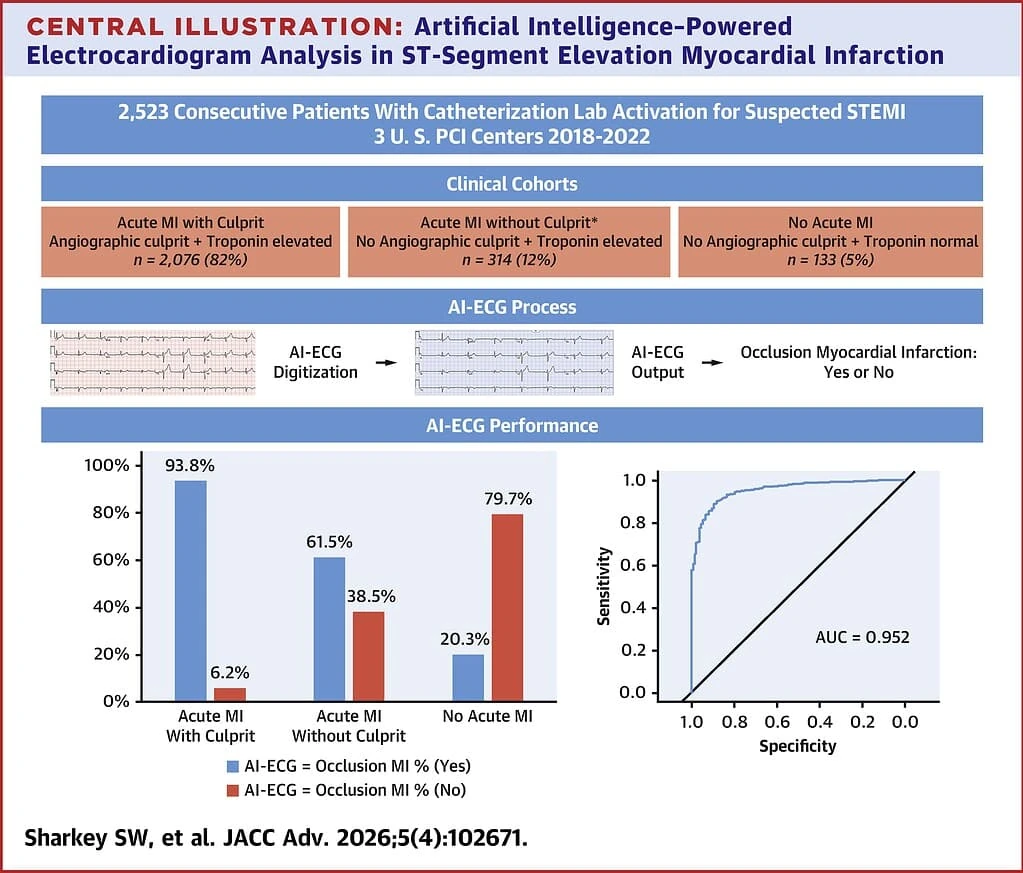
Consecutive patients were gathered from a multicenter U.S. STEMI registry (2018-2022) and categorized into 3 clinical cohorts based on the presence or absence of angiographic culprit and troponin elevation: acute myocardial infarction (AMI) with culprit, AMI without culprit, and no-AMI. Cardiac catheterization laboratory-activating ECGs were analyzed using an AI-ECG model trained to identify acute coronary occlusion and classified as occlusion myocardial infarction, OMI(+) or not, OMI(−).
Results
The study included 2,523 patients, 68.3% male, with a median age of 63 years. AMI with culprit was present in 2076 (82.3%), AMI without culprit in 314 (12.4%), and no-AMI in 133 (5.3%). Among AMI with culprit patients, the model correctly identified 93.8% as OMI(+). Sensitivity for TIMI flow 0/1, 2, and 3 was 96.3%, 93.1%, and 86.9%, respectively; P < 0.001. The model correctly identified 79.7% of no-AMI patients as OMI(−). The AUCROC was 0.952 (95% CI: 0.924-0.966). The AMI without culprit cohort included takotsubo syndrome OMI(+) = 78%, MI with nonobstructive coronary arteries OMI(+) = 61%, and myopericarditis OMI(+) = 67%.
Conclusion
In suspected STEMI, this AI-ECG model correctly identified nearly all patients with acute coronary obstruction and most of those without AMI. If prospectively validated, this approach could improve the management of patients with suspected AMI.
Authors: Scott W. Sharkey, Robert Herman, Dawn R. Witt, Frank Aguirre, Mehmet Yildiz, David M. Larson, Avinash Murthy, Heather S. Rohm, Stephen W. Smith, Will Belzer, Jenny Chambers, Ellen Cravero, Seth Bergstedt, Greg Kerola, David Farmer, Andrew Willett, H. Pendell Meyers, Julia Harris, Christopher VanHove, and Timothy D. Henry
Share this article



About PMcardio
PMcardio is the market leader in AI-powered diagnostics, addressing the world’s leading cause of death – cardiovascular diseases. The innovative clinical assistant empowers healthcare professionals to detect up to 40 cardiovascular diseases. In the form of a smartphone application, the certified Class IIb medical device interprets any 12-lead ECG image in under 5 seconds to provide accurate diagnoses and individualized treatment recommendations tailored to each patient.

About Powerful Medical
Powerful Medical leads one of the most important shifts in modern medicine by augmenting human-made clinical decisions with artificial intelligence. Our primary focus is on cardiovascular diseases, the world’s leading cause of death.
Established in 2017, Powerful Medical has embarked on a mission to revolutionize the diagnosis and treatment of cardiovascular diseases. We are a medical company backed by 28 world-class cardiologists and led by our expert Scientific Board with decades of experience in daily patient care, clinical research, and medical devices. The results of our research are implemented, developed, certified, and brought to market by our 50+ strong interdisciplinary team of physicians, data scientists, AI experts, software engineers, regulatory specialists, and commercial teams.