
Artificial Intelligence Versus Human Expertise: ECG-Based Detection of Occlusive Myocardial Infarction After Cardiac Arrest
Overview
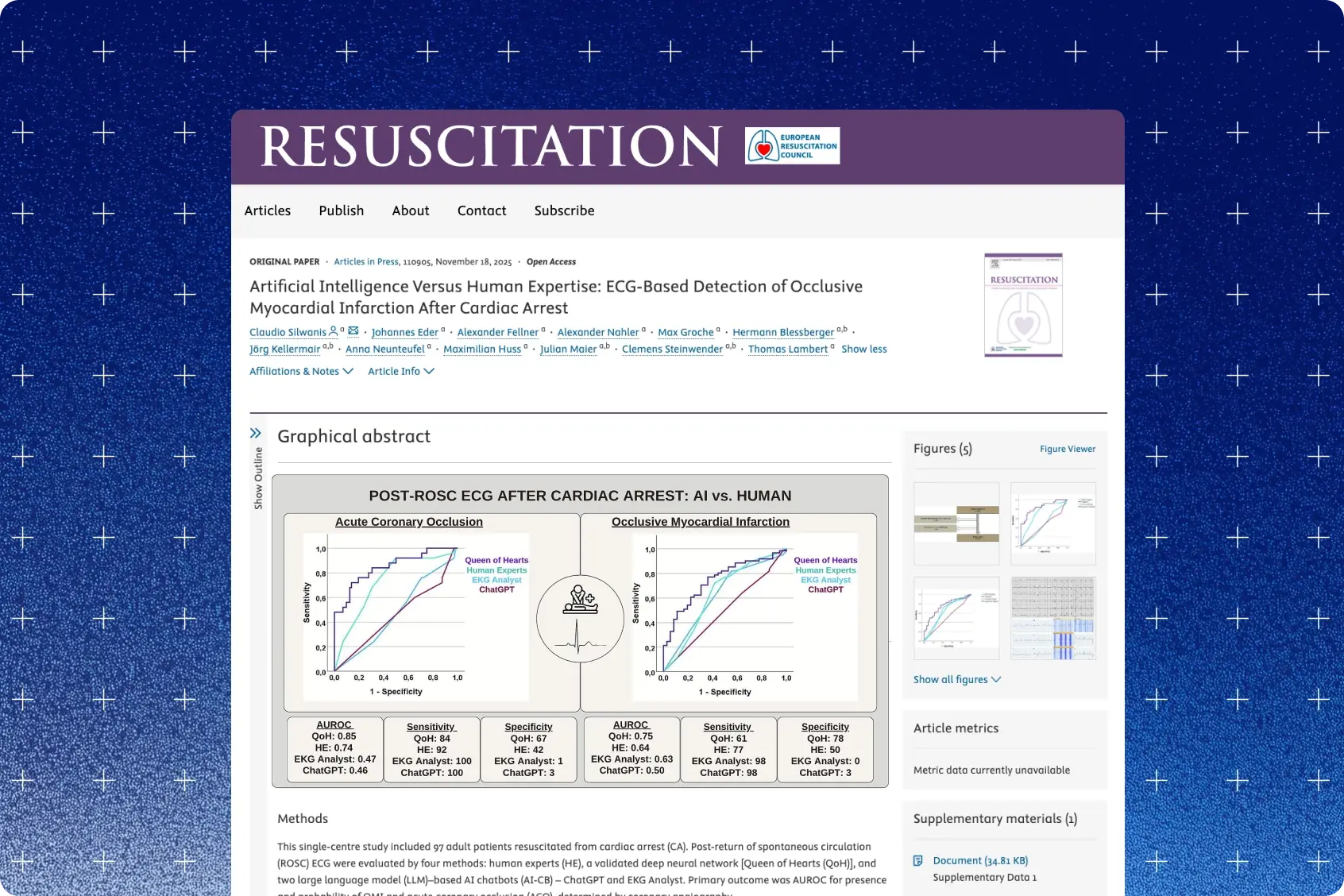
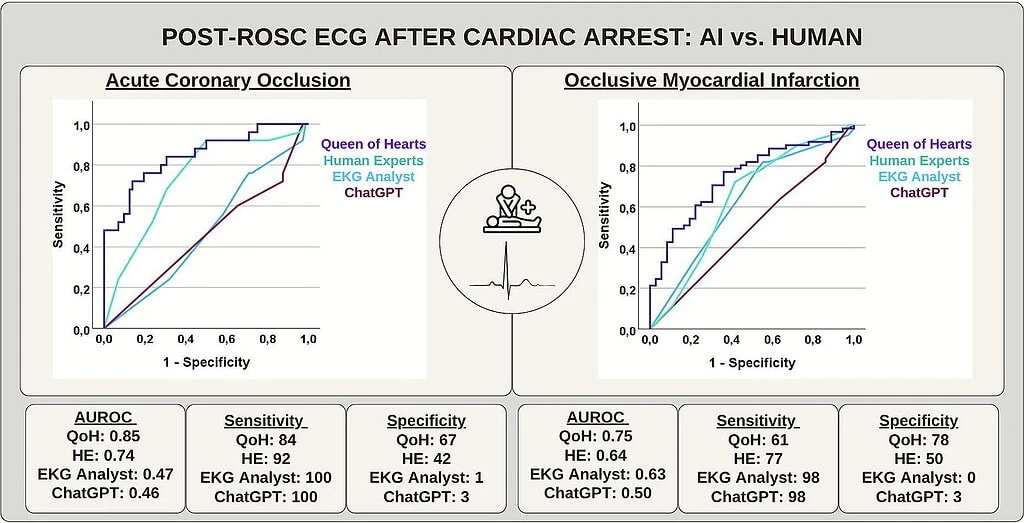
This single-centre study tested whether AI-based ECG analysis can detect occlusive myocardial infarction (OMI) after cardiac arrest using post-ROSC ECGs from 97 patients with subsequent coronary angiography. A dedicated deep neural network (Queen of Hearts, QoH) achieved the highest discrimination for acute coronary occlusion (AUC 0.85) and OMI (AUC 0.75), outperforming human experts, with a more balanced trade-off between sensitivity and specificity. In contrast, two large language model–based chatbots (ChatGPT and a GPT-based EKG Analyst) showed near-perfect sensitivity but almost no specificity, labelling nearly all ECGs as OMI and thus providing no meaningful diagnostic discrimination. These findings suggest that specialized ECG-trained AI, such as QoH, may serve as a useful adjunct in post-resuscitation decision-making. In contrast, general-purpose LLMs are currently unsuitable for critical ECG diagnosis.
Key findings
- 97 post-ROSC patients with subsequent coronary angiography.
- AI AUC 0.85 for occlusion, 0.75 for OMI — outperforming human experts.
- ChatGPT and a GPT-based analyst had near-zero specificity.
Published in: Resuscitation
Published on: 19 November 2025
Background
Accurate electrocardiogram (ECG) interpretation after cardiac arrest is essential for identifying occlusive myocardial infarction (OMI), but post-resuscitation artifacts make this challenging. While artificial intelligence (AI) offers promising support, its diagnostic performance in this critical setting remains uncertain.
Methods
This single-centre study included 97 adult patients resuscitated from cardiac arrest (CA). Post-return of spontaneous circulation (ROSC), ECGs were evaluated by four methods: human experts (HE), a validated deep neural network (Queen of Hearts [QoH]), and two large language model (LLM)–based AI chatbots (AI-CB) – ChatGPT and EKG Analyst. The primary outcome was the AUROC for the presence and probability of OMI and acute coronary occlusion (ACO), determined by coronary angiography.
Results
For ACO (TIMI 0), QoH yielded the highest AUROC (0.846 [0.752–0.939]), followed by HE (0.735 [0.622 – 0.848]). Both AI-CB resulted in the lowest AUROC (ChatGPT: 0.456 [0.319 – 0.592]; EKG Analyst: 0.474 [0.346 – 0.603]. For OMI (TIMI 0-2 or TIMI 3 + peak-troponin), QoH again achieved the highest AUROC (0.745 [0.647 – 0.843]), followed by HE (0.635 [0.515 – 0.755]), AI-CB were lowest again (ChatGPT: 0.495 [0.376 – 0.614]; EKG Analyst: 0.626 [0.508 – 0.743]. Threshold-dependent performance metrics revealed high sensitivity (ACO: 100%; OMI: 98.36%) for both AI-CB, at the cost of minimal specificity. QoH and HE showed more even distributions of sensitivity/specificity.
Conclusion
QoH, despite operating without awareness of the CA-setting and thus likely at a relative disadvantage, and HE showed robust diagnostic accuracy. Due to undifferentiated overdiagnosis, general LLMs remain unsuitable for ECG interpretation. Domain-specific tools, such as QoH, may offer complementary value.
Authors: Claudio Silwanis, Johannes Eder, Alexander Fellner, Alexander Nahler, Max Groche, Hermann Blessberger, Jörg Kellermair, Anna Neunteufel, Maximilian Huss, Julian Maier, Clemens Steinwender, Thomas Lambert
Share this article



About PMcardio
PMcardio is the market leader in AI-powered diagnostics, addressing the world’s leading cause of death – cardiovascular diseases. The innovative clinical assistant empowers healthcare professionals to detect up to 40 cardiovascular diseases. In the form of a smartphone application, the certified Class IIb medical device interprets any 12-lead ECG image in under 5 seconds to provide accurate diagnoses and individualized treatment recommendations tailored to each patient.

About Powerful Medical
Powerful Medical leads one of the most important shifts in modern medicine by augmenting human-made clinical decisions with artificial intelligence. Our primary focus is on cardiovascular diseases, the world’s leading cause of death.
Established in 2017, Powerful Medical has embarked on a mission to revolutionize the diagnosis and treatment of cardiovascular diseases. We are a medical company backed by 28 world-class cardiologists and led by our expert Scientific Board with decades of experience in daily patient care, clinical research, and medical devices. The results of our research are implemented, developed, certified, and brought to market by our 50+ strong interdisciplinary team of physicians, data scientists, AI experts, software engineers, regulatory specialists, and commercial teams.