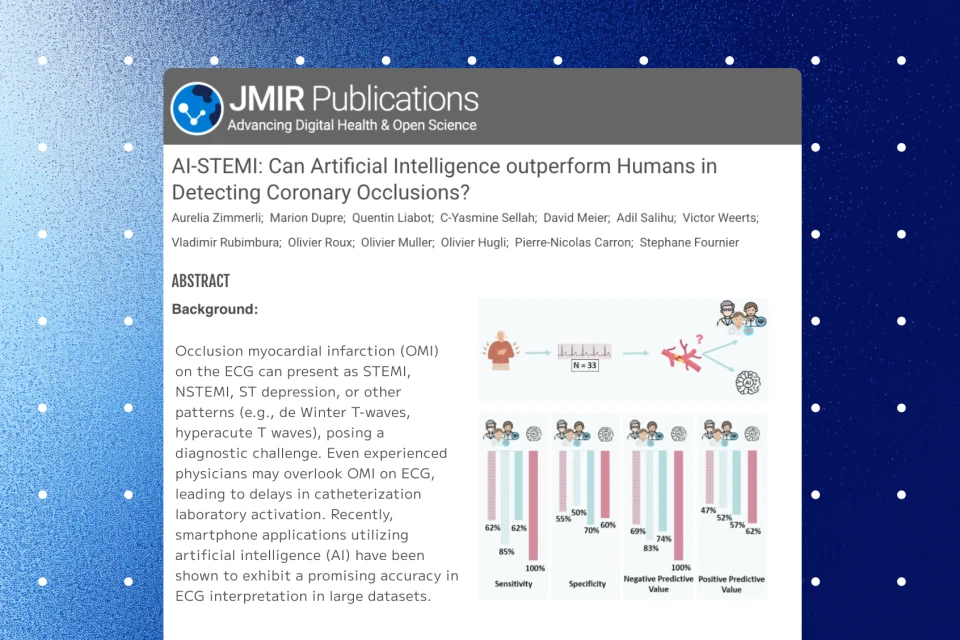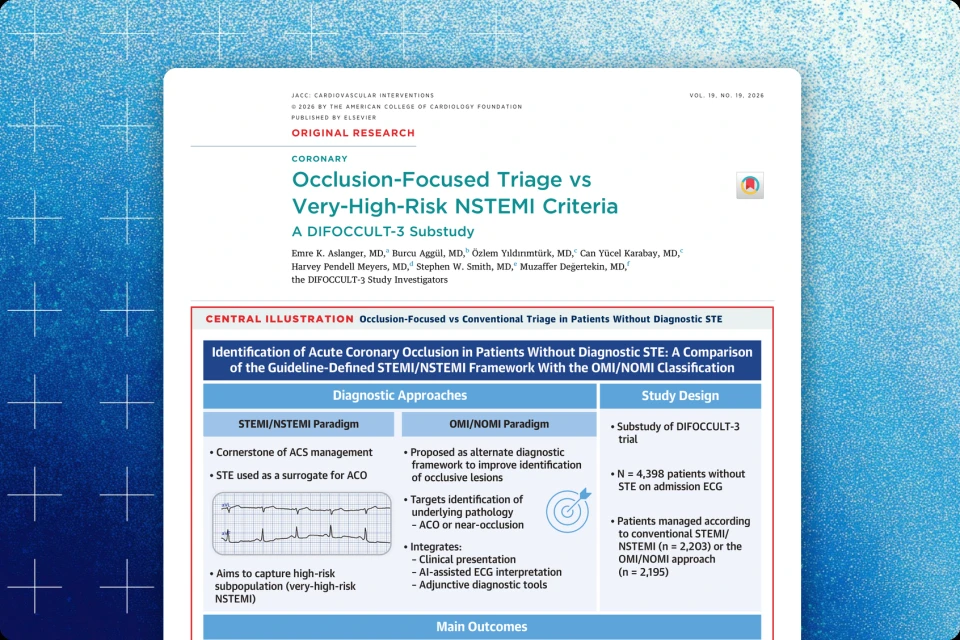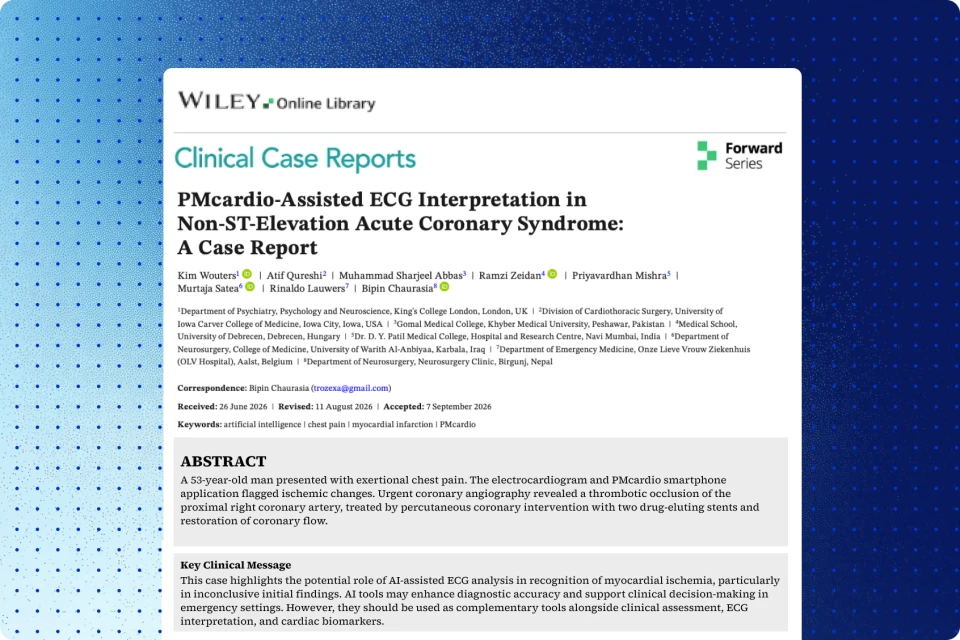

AI-enhanced recognition of occlusions in acute coronary syndrome (AERO-ACS): a retrospective study
Overview
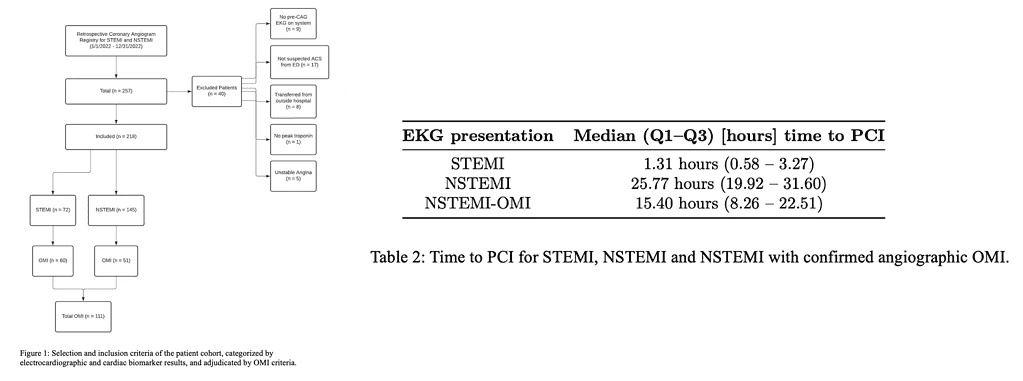
In a one-year, single-centre cohort of 217 cath-lab patients (72 STEMI, 145 NSTEMI), the AERO-ACS study tested PMcardio’s AI ECG against traditional ST-elevation rules for detecting angiographic occlusion-MI. The algorithm matched STEMI sensitivity (86.5 % vs 83.3 %) while raising specificity to 82.2 % (vs 66.0 %), achieved 100 % sensitivity in STEMI cases, and flagged occlusions linked to a 12-fold higher in-hospital mortality risk—suggesting more accurate triage with fewer unnecessary activations.
Key findings
- Cohort of 217 cath-lab patients (72 STEMI, 145 NSTEMI).
- Specificity 82.2% vs 66.0% for STEMI criteria; 100% sensitivity in STEMI.
- Detected occlusions linked to a 12-fold higher in-hospital mortality.
Published in: Coronary Artery Disease
Published on: 25 July 2025
Background
Artificial intelligence (AI) augmentation of ECG assessment has significant potential to improve patient outcomes in acute coronary syndrome.
Methods
We used a 1-year retrospective cohort of angiographic data from patients presenting with ST-elevation myocardial infarction (STEMI) and non-ST-elevation myocardial infarction (NSTEMI). The device analyzed precatheterization ECGs to identify OMI, defined as a culprit vessel with thrombolysis In myocardial infarction (TIMI) 0–2 flow or TIMI 3 flow and peak cardiac troponin I > 10.0 ng/ml.
Results
A total of 217 patients were included: 72 STEMI (32%) and 145 NSTEMI (65%). Angiographic OMI was confirmed in 60 (83%) STEMI and 51 (35%) NSTEMI cases. The AI model achieved a sensitivity of 86.5%, specificity of 82.2%, and an area under the curve of 0.84. Traditional STEMI criteria had a sensitivity of 83.3% and a specificity of 66.0%. The AI model was 100% sensitive in detecting STEMI-OMI. The odds ratio for mortality in AI-detected OMI patients was 12.44 (1.56–98.98), unplanned readmissions 1.15 (0.53–2.51), and reduced ejection fraction at 1 year 0.24 (0.26–2.16).
Conclusion
The AI model demonstrated similar sensitivity but higher specificity than traditional STEMI criteria, improving OMI detection while reducing false positives. These findings suggest potential benefits in triage accuracy and resource utilization, but further prospective validation is needed to determine its clinical impact.
Authors: Choi, James W.H.; Torelli, Vincent; Silverman, Alex; Diaz, Sara Saravia; Kong, Darren; Vaish, Esha; Katic, Luka; Nagourney, Alex; Khan, Zara; Robbins, Lexi; Pinney, Sean; Barman, Nitin; Farhan, Serdar
Share this article



About PMcardio
PMcardio is the market leader in AI-powered diagnostics, addressing the world’s leading cause of death – cardiovascular diseases. The innovative clinical assistant empowers healthcare professionals to detect up to 40 cardiovascular diseases. In the form of a smartphone application, the certified Class IIb medical device interprets any 12-lead ECG image in under 5 seconds to provide accurate diagnoses and individualized treatment recommendations tailored to each patient.

About Powerful Medical
Powerful Medical leads one of the most important shifts in modern medicine by augmenting human-made clinical decisions with artificial intelligence. Our primary focus is on cardiovascular diseases, the world’s leading cause of death.
Established in 2017, Powerful Medical has embarked on a mission to revolutionize the diagnosis and treatment of cardiovascular diseases. We are a medical company backed by 28 world-class cardiologists and led by our expert Scientific Board with decades of experience in daily patient care, clinical research, and medical devices. The results of our research are implemented, developed, certified, and brought to market by our 50+ strong interdisciplinary team of physicians, data scientists, AI experts, software engineers, regulatory specialists, and commercial teams.