
AI-STEMI: Can Artificial Intelligence Outperform Humans in Detecting Coronary Occlusions?
Overview
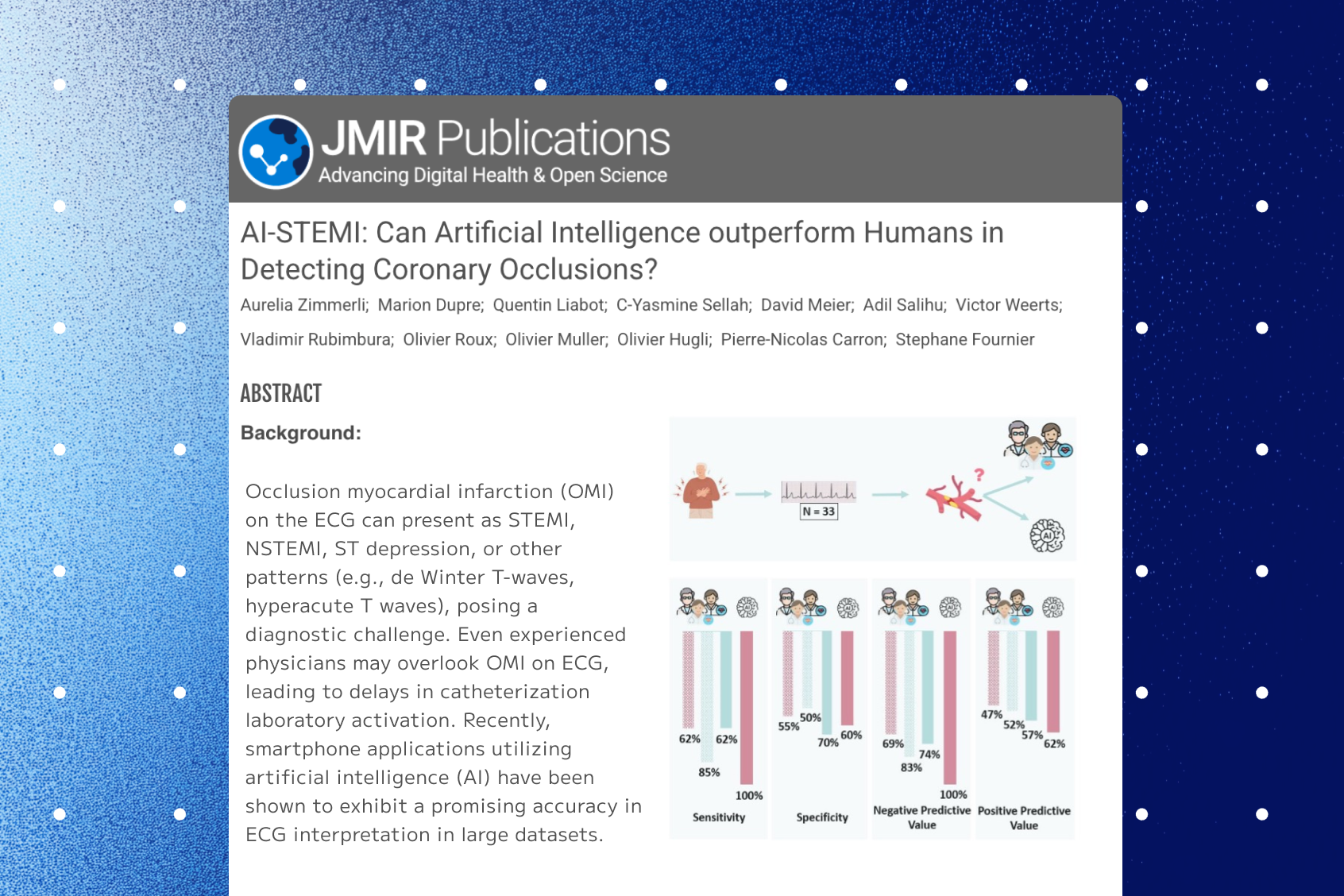
Non-pathognomonic ECGs that generate diagnostic debate are a major challenge in ruling out occlusion myocardial infarction (OMI). This retrospective study at Lausanne University Hospital (CHUV) compared the Queen of Hearts-powered PMcardio application with three interventional cardiologists interpreting 33 diagnostically challenging ECGs with an adjudicated final diagnosis. Queen of Hearts detected all 13 confirmed OMI cases (100% sensitivity and negative predictive value), while the cardiologists' sensitivities ranged from 62% to 85%, and the AI's overall misclassification rate (24%) was lower than the cardiologists' (33%-42%, p=0.02). The findings support Queen of Hearts-assisted ECG interpretation as a valuable adjunct for STEMI-pathway activation decisions on ambiguous ECGs.
Key findings
- The Queen of Hearts AI (via the PMcardio app) identified all 13 confirmed OMI cases in the cohort — 100% sensitivity and 100% negative predictive value.
- The three interventional cardiologists achieved sensitivities of only 62%, 85%, and 62% on the same ECGs.
- Queen of Hearts' overall misclassification rate was 24%, versus 33%-42% for the cardiologists (p=0.02 vs. consensus).
- The three cardiologists agreed unanimously on only 18 of 33 ECGs, underscoring substantial inter-reader variability.
Published in: Journal of Medical Internet Research (JMIR)
Published on: 9 July 2026
Background
Occlusion myocardial infarction (OMI) can present on ECG as STEMI, NSTEMI, ST depression, or other atypical "STEMI-equivalent" patterns, posing a persistent diagnostic challenge. Conventional STEMI criteria are highly specific (>95%) but poorly sensitive (just above 40%), and more than 25% of NSTEMI patients are later found to have a totally occluded culprit vessel on angiography. This study compared the diagnostic performance of the Queen of Hearts-powered PMcardio application with that of interventional cardiologists in interpreting non-pathognomonic ECGs that generated diagnostic debate.
Methods
In this single-center retrospective study at Lausanne University Hospital (CHUV), 33 diagnostically challenging ECGs — consecutively submitted to the on-call interventional cardiologist between February 26, 2019, and May 21, 2020, from patients with written informed consent and an adjudicated final diagnosis — were included. Three interventional cardiologists, blinded to the final diagnosis, independently assessed whether each ECG warranted activation of the STEMI pathway for immediate invasive angiography. The same ECGs were analyzed by Queen of Hearts via the PMcardio application. Coronary angiography, with any lesion ≥90% stenosis considered positive, served as the reference standard.
Results
Of 33 patients, 29 (88%) had a cardiac cause of chest pain, including 23 acute coronary syndromes, of which 13 (57%) were OMI. The three cardiologists achieved sensitivities of 62%, 85%, and 62%; specificities of 70%, 50%, and 55%; positive predictive values of 57%, 52%, and 47%; and negative predictive values of 74%, 83%, and 69%, with misclassification rates of 33%, 36%, and 42%. In contrast, Queen of Hearts achieved a sensitivity and negative predictive value of 100%, a specificity of 60%, a positive predictive value of 62%, and an overall misclassification rate of 24% — significantly outperforming the cardiologists' consensus diagnosis (McNemar's test, p=0.02). All three cardiologists agreed on the same diagnosis in only 18 of 33 cases. In one illustrative case, an occluded marginal branch artery was correctly flagged by Queen of Hearts but missed by all three cardiologists.
Conclusion
In this retrospective study of 33 real-life challenging ECGs, Queen of Hearts demonstrated higher sensitivity and a lower misclassification rate than interventional cardiologists for detecting occlusion myocardial infarction, supporting its potential as an adjunctive tool for clinical decision-making in ambiguous presentations.
Share this article



About PMcardio
PMcardio is the market leader in AI-powered diagnostics, addressing the world’s leading cause of death – cardiovascular diseases. The innovative clinical assistant empowers healthcare professionals to detect up to 40 cardiovascular diseases. In the form of a smartphone application, the certified Class IIb medical device interprets any 12-lead ECG image in under 5 seconds to provide accurate diagnoses and individualized treatment recommendations tailored to each patient.

About Powerful Medical
Powerful Medical leads one of the most important shifts in modern medicine by augmenting human-made clinical decisions with artificial intelligence. Our primary focus is on cardiovascular diseases, the world’s leading cause of death.
Established in 2017, Powerful Medical has embarked on a mission to revolutionize the diagnosis and treatment of cardiovascular diseases. We are a medical company backed by 28 world-class cardiologists and led by our expert Scientific Board with decades of experience in daily patient care, clinical research, and medical devices. The results of our research are implemented, developed, certified, and brought to market by our 50+ strong interdisciplinary team of physicians, data scientists, AI experts, software engineers, regulatory specialists, and commercial teams.