
Specificity of the Occlusion Myocardial Infarction-Trained PMcardio "Queen of Hearts" AI-ECG in Inflammatory Myopericardial Syndromes — A Comparison With Guideline Criteria and Large Language Models
Overview
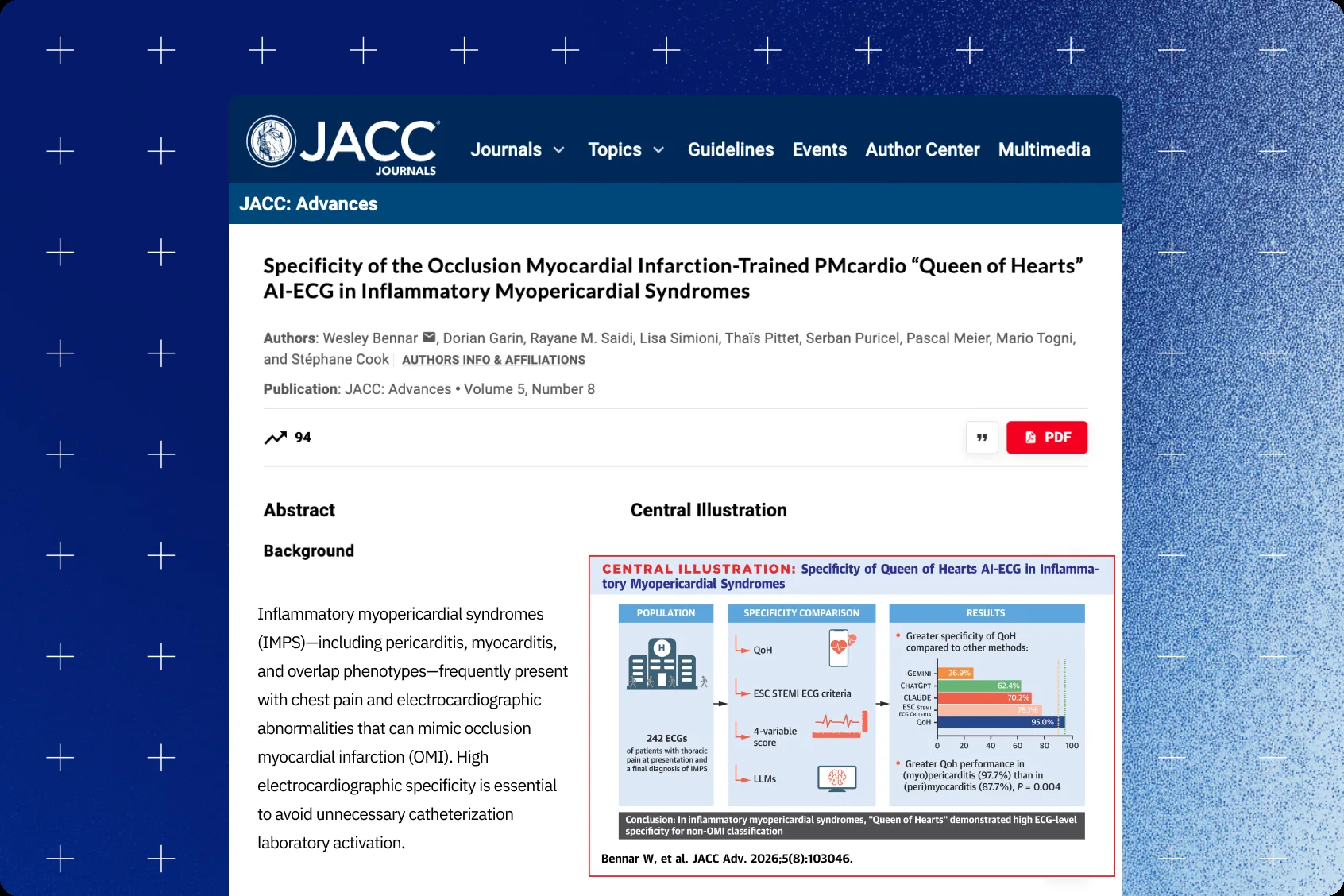
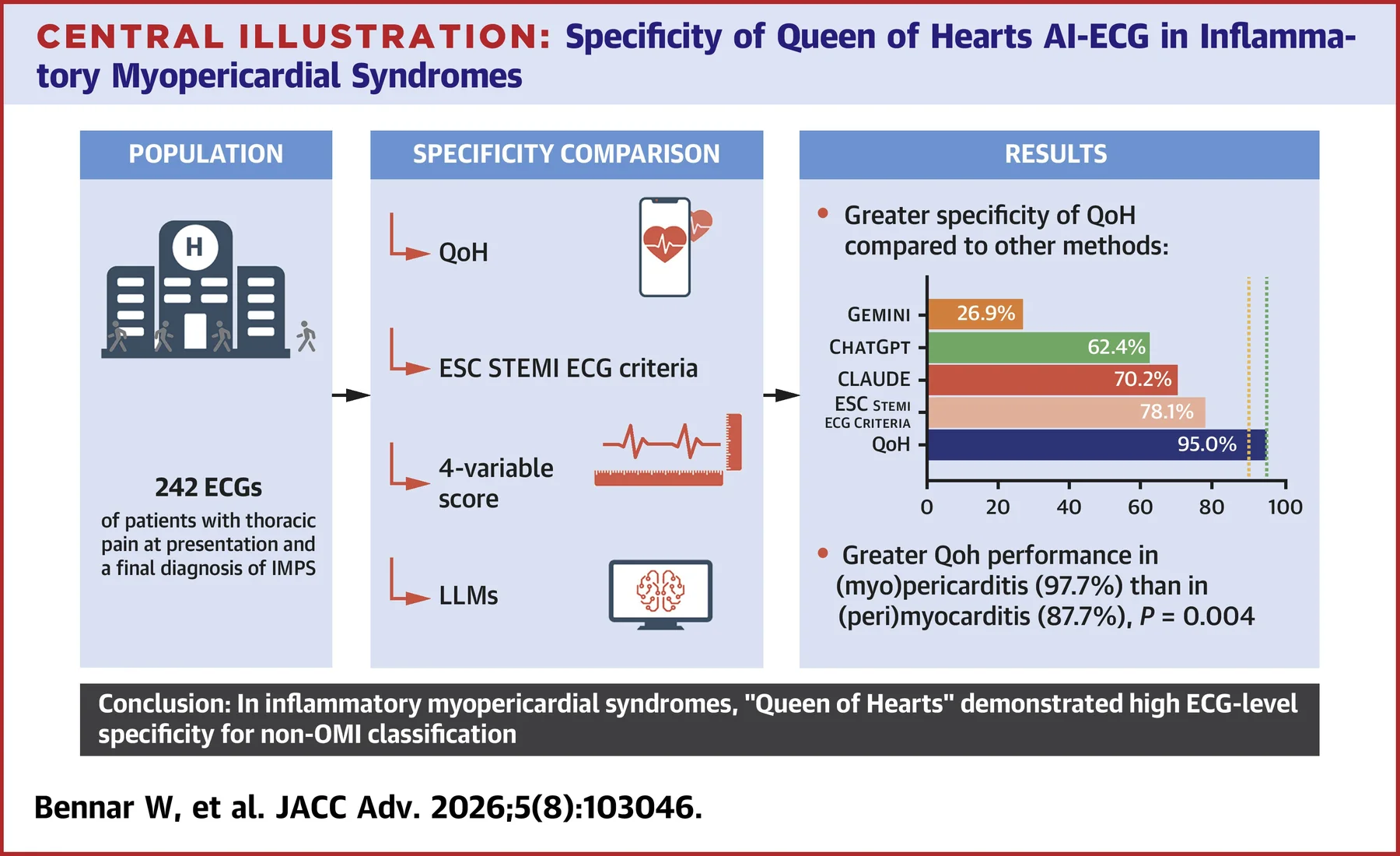
Inflammatory myopericardial syndromes can mimic occlusion myocardial infarction (OMI) on ECG, risking unnecessary catheterization lab activations. This retrospective study found the OMI-trained PMcardio Queen of Hearts (QoH) AI-ECG model reached 95.0% specificity for excluding OMI in 242 patients with these syndromes, versus 78.1% for ESC STEMI criteria and 26.9%–70.2% for three general-purpose LLMs. Discordant cases showed diffuse, nonterritorial ECG patterns typical of inflammatory disease rather than focal ischemia.
Key findings
- QoH specificity was 95.0% (95% CI 91.5–97.1%) across 242 patients with inflammatory myopericardial syndromes, versus 78.1% for ESC STEMI criteria.
- All three general-purpose LLMs performed worse: 26.9%–70.2% specificity (Claude Opus 4.5 best at 70.2%, then ChatGPT at 62.4%, then Gemini at 26.9%).
- Specificity was higher in pure (myo)pericarditis (97.7%) than in cases with myocardial involvement, (peri)myocarditis (87.7%).
- 43 discordant ESC-positive/QoH-negative cases showed diffuse, nonterritorial inflammatory ECG patterns rather than focal occlusion signs.
Published in: JACC Advances
Published on: 28 July 2026
Background
Inflammatory myopericardial syndromes (IMPS) — pericarditis, myocarditis, and overlap phenotypes — are common non-ischemic causes of acute chest pain whose ECG changes can mimic occlusion myocardial infarction (OMI). AI-ECG models trained on angiographic OMI endpoints, notably PMcardio's Queen of Hearts (QoH), have outperformed STEMI criteria and expert interpretation, but whether QoH avoids false-positive OMI calls on inflammatory ST changes remained untested. This study assessed QoH specificity in an IMPS-only cohort against ESC STEMI criteria, a 4-variable formula, and three general-purpose large language models (LLMs).
Methods
The authors conducted a single-center retrospective study of consecutive emergency department patients with adjudicated IMPS at the University & Hospital of Fribourg (2010–2025). Diagnoses were set by two cardiologists blinded to QoH/LLM outputs, with obstructive coronary disease excluded by angiography and/or cardiac MRI. Each patient's first 12-lead ECG was analyzed with QoH (PMcardio App v3.4.1) and compared against ESC STEMI criteria, the 4-variable formula, and three LLMs (ChatGPT 5.2, Claude Opus 4.5, Gemini 3). The primary endpoint was ECG-level specificity for non-OMI classification, with secondary analyses by ECG territory and IMPS phenotype.
Results
Among 242 patients with confirmed IMPS, QoH reached 95.0% specificity (95% CI: 91.5%-97.1%), versus 78.1% for ESC STEMI criteria and 72.9%-73.3% for the 4-variable formula. All three LLMs performed worse: Claude Opus 4.5 was best at 70.2%, followed by ChatGPT at 62.4% and Gemini at 26.9% (all P < 0.001 vs QoH). Specificity was higher in pure (myo)pericarditis (97.7%) than in (peri)myocarditis with myocardial involvement (87.7%, P = 0.004). Among 43 discordant ESC-positive/QoH-negative cases, review found recurrent inflammatory features — notched J-points (74.4%), concave ST morphology (74.4%), multi-territorial STE (67.4%), and PR depression (30.2%) — rather than focal occlusion patterns.
Conclusion
In this IMPS-only cohort, the OMI-trained Queen of Hearts model showed substantially higher specificity for excluding OMI than ESC STEMI criteria, the 4-variable formula, and three general-purpose LLMs, supporting its potential to reduce unnecessary catheterization laboratory activations in inflammatory myopericardial disease.
Share this article



About PMcardio
PMcardio is the market leader in AI-powered diagnostics, addressing the world’s leading cause of death – cardiovascular diseases. The innovative clinical assistant empowers healthcare professionals to detect up to 40 cardiovascular diseases. In the form of a smartphone application, the certified Class IIb medical device interprets any 12-lead ECG image in under 5 seconds to provide accurate diagnoses and individualized treatment recommendations tailored to each patient.

About Powerful Medical
Powerful Medical leads one of the most important shifts in modern medicine by augmenting human-made clinical decisions with artificial intelligence. Our primary focus is on cardiovascular diseases, the world’s leading cause of death.
Established in 2017, Powerful Medical has embarked on a mission to revolutionize the diagnosis and treatment of cardiovascular diseases. We are a medical company backed by 28 world-class cardiologists and led by our expert Scientific Board with decades of experience in daily patient care, clinical research, and medical devices. The results of our research are implemented, developed, certified, and brought to market by our 50+ strong interdisciplinary team of physicians, data scientists, AI experts, software engineers, regulatory specialists, and commercial teams.