
Leveraging PMcardio to Boost Enhanced Services Reimbursements

Discover how PMcardio aids NHS GP practices in earning more by enhancing the detection and management of cardiovascular conditions under the Enhanced Services program.
Are you a UK-based GP looking to improve the financial health of your practice? If so, Enhanced Services are a vital component of the NHS funding model and can play a significant role in the financial stability of your practice. The Enhanced Services Reimbursement is the additional funding that NHS GP practices in the UK receive for providing certain services beyond their core contractual requirements.
These services are intended to improve the quality of care provided to patients and increase the financial stability of practices. One key area that practices can focus on to increase their earnings is the diagnosis and management of cardiovascular conditions, such as atrial fibrillation, hypertension, and heart failure. But how can you ensure that you are accurately diagnosing and managing these conditions to maximise your reimbursement under Enhanced Services?
In this blog post, we’ll explore how PMcardio can help you improve the detection and management of cardiovascular conditions, leading to greater reimbursements and improved financial health for your practice.
Enhanced Services and Cardiovascular Conditions
By offering enhanced services for cardiovascular conditions, primary care practices and healthcare providers can improve the quality of care for patients with these conditions and help to reduce the burden of cardiovascular disease on healthcare systems. Cardiovascular conditions refer to diseases or disorders that affect the heart and blood vessels. These can include coronary artery disease, heart failure, arrhythmias, and hypertension, among others. Cardiovascular conditions are a major cause of morbidity and mortality worldwide and represent a significant burden on healthcare systems.
Primary care practices or healthcare providers may offer specific services related to the management and prevention of cardiovascular conditions. Examples of enhanced services for cardiovascular conditions may include:
- Structured management programs for patients with hypertension or heart failure, which can include regular monitoring of blood pressure and symptoms, medication management, and lifestyle counselling.
- Screening programs to identify patients at risk of developing cardiovascular disease, which can include assessments of risk factors such as smoking, obesity, and family history.
- Referral pathways to specialist cardiovascular services for patients with complex or severe cardiovascular conditions.
- Health promotion programs to encourage patients to adopt healthy lifestyles and reduce their risk of developing cardiovascular disease.
For cardiovascular conditions, such as atrial fibrillation, hypertension, and heart failure, reimbursement is based on the achievement of specific QOF (Quality and Outcomes Framework) indicators related to the diagnosis, treatment, and management of these conditions. The maximum number of QOF points that can be earned for each indicator varies, and the total number of points achieved determines the level of reimbursement received by the GP practice.
The level of reimbursement for Enhanced Services may also be subject to negotiation between individual GP practices and their respective Clinical Commissioning Groups (CCGs). However, the QOF indicators provide a standardised framework for reimbursement, and GP practices can use them to maximise their income from Enhanced Services.
The Advantage of using PMcardio
PMcardio’s AI-powered ECG analysis supports the diagnosis of multiple cardiovascular conditions with high sensitivity and specificity. This accuracy allows GP practices to identify and manage patients with these conditions more effectively, ensuring that they receive appropriate care and treatment.
By utilising PMcardio to diagnose and manage these cardiovascular conditions, GP practices can potentially earn additional Enhanced Services reimbursements, as shown in the table below.
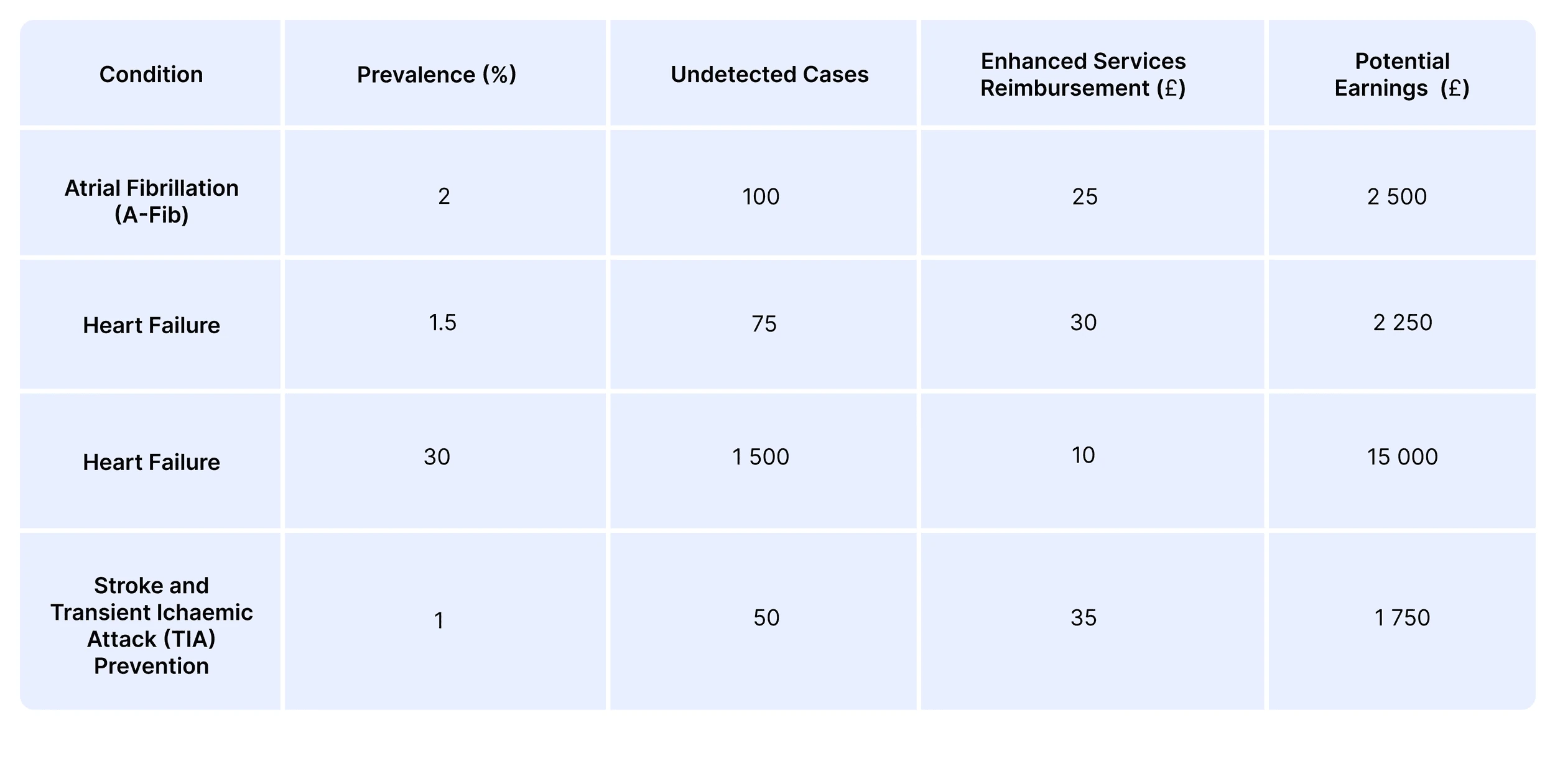
By incorporating PMcardio into your GP practice, you can optimise Enhanced Services reimbursements through precise diagnosis and management of cardiovascular conditions. PMcardio’s demonstrated precision and extensive ECG analysis capabilities make it an invaluable resource for GP practices, allowing them to enhance patient care and boost their earnings under the Enhanced Services program.
Share this article



About PMcardio
PMcardio is a CE-marked Class IIb AI medical device that interprets any 12-lead ECG — from a photo or a digital file — in seconds. It detects 50+ ECG findings, including occlusion myocardial infarction (OMI) — the acute coronary occlusions that conventional STEMI criteria miss in over half of cases. Its Queen of Hearts™ OMI model holds FDA Breakthrough Device Designation, and PMcardio is already used by 100,000+ clinicians who have analyzed more than 2.5 million ECGs.

About Powerful Medical
Powerful Medical is a medical-technology company using artificial intelligence to transform how cardiovascular disease — the world’s leading cause of death — is diagnosed. Founded in 2017, it built PMcardio, the world’s first AI medical device to detect acute coronary occlusion (OMI) from an ECG. Its research is published in the European Heart Journal – Digital Health and validated across 25+ clinical studies, and its Queen of Hearts™ model earned FDA Breakthrough Device Designation. To date, PMcardio has supported the detection of 120,000+ heart attacks across 150+ hospital deployments worldwide.