
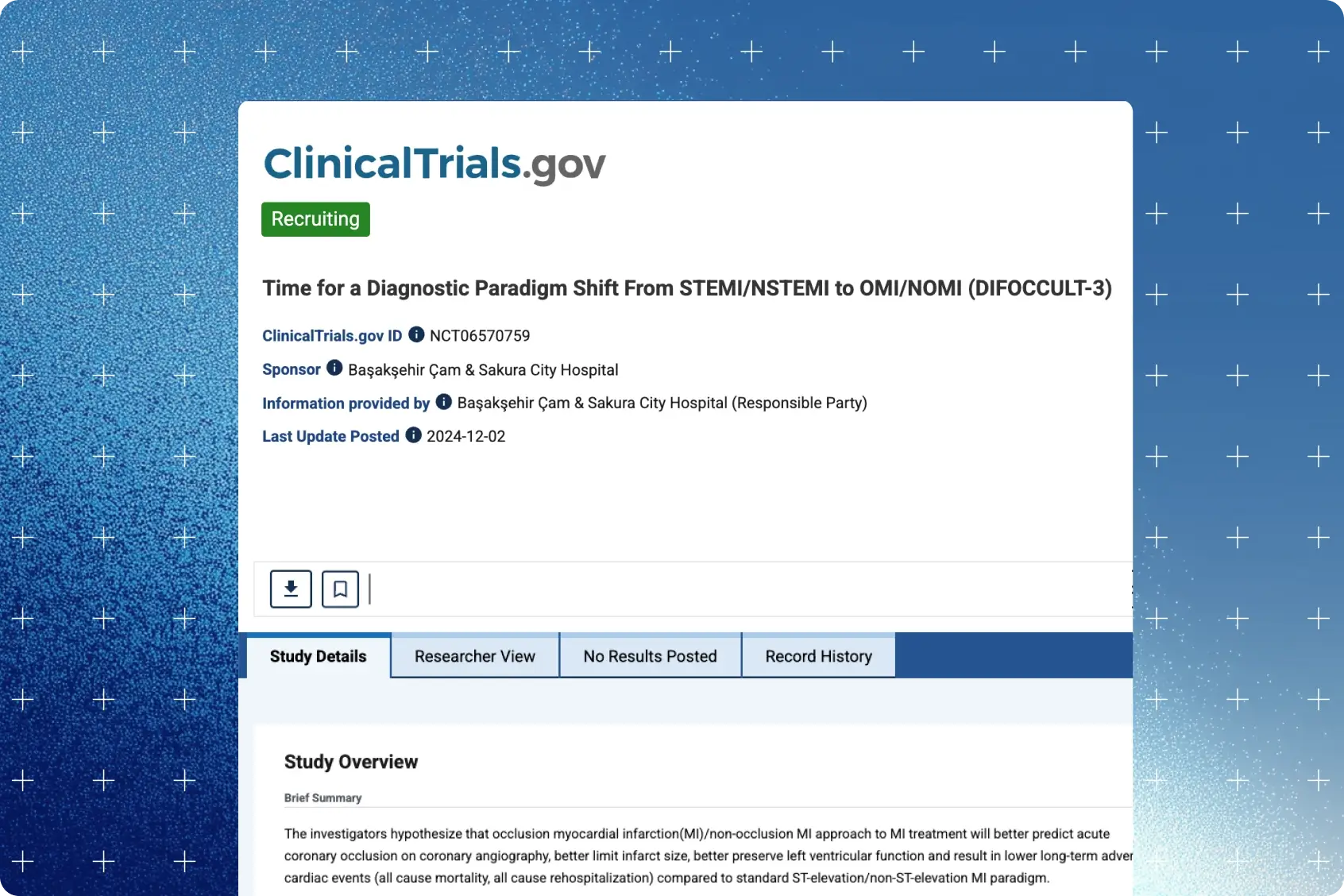
Time for a Diagnostic Paradigm Shift From STEMI/NSTEMI to OMI/NOMI (DIFOCCULT-3)
Overview
DIFOCCULT-3 is a randomized controlled study actively enrolling patients across 23 sites in Turkey. It evaluates AI-assisted ECG interpretation in detecting high-risk heart attack patterns. By comparing traditional STEMI/NSTEMI classification with an occlusion/non-occlusion model, the trial aims to improve acute coronary blockage detection. The primary endpoint includes patient mortality and re-hospitalization at 1-year follow-up, assessing its impact on long-term patient outcomes.
Key findings
- Randomized controlled trial enrolling across 23 sites in Turkey.
- Compares an OMI/NOMI model against traditional STEMI/NSTEMI classification.
- Primary endpoint: 1-year mortality and re-hospitalization.
Summary
DIFOCCULT-3 is a randomized controlled study actively enrolling patients across 18 sites in Turkey. It evaluates AI-assisted ECG interpretation in detecting high-risk heart attack patterns.
By comparing traditional STEMI/NSTEMI classification with an occlusion/non-occlusion (OMI/NOMI) model, the trial aims to improve acute coronary occlusion detection. The primary composite endpoint includes all-cause mortality and all-cause re-hospitalization at 1-year follow-up, assessing its impact on long-term patient outcomes.
| Study Design | Randomized Controlled Trial (RCT) |
| Status | Enrolling patients |
| Countries / Sites | 1 (Turkey) / 18 |
| Study Start | October 1, 2024 |
| Primary Completion(estimated) | October 1, 2025 |
| Enrollment (target) | 6,000 |
| clinicaltrials.gov ID | NCT06570759 |
Share this article



About PMcardio
PMcardio is the market leader in AI-powered diagnostics, addressing the world’s leading cause of death – cardiovascular diseases. The innovative clinical assistant empowers healthcare professionals to detect up to 40 cardiovascular diseases. In the form of a smartphone application, the certified Class IIb medical device interprets any 12-lead ECG image in under 5 seconds to provide accurate diagnoses and individualized treatment recommendations tailored to each patient.

About Powerful Medical
Powerful Medical leads one of the most important shifts in modern medicine by augmenting human-made clinical decisions with artificial intelligence. Our primary focus is on cardiovascular diseases, the world’s leading cause of death.
Established in 2017, Powerful Medical has embarked on a mission to revolutionize the diagnosis and treatment of cardiovascular diseases. We are a medical company backed by 28 world-class cardiologists and led by our expert Scientific Board with decades of experience in daily patient care, clinical research, and medical devices. The results of our research are implemented, developed, certified, and brought to market by our 50+ strong interdisciplinary team of physicians, data scientists, AI experts, software engineers, regulatory specialists, and commercial teams.